What does Broadcom's price count on?
Broadcom's own AI goal, a year late. At $321.68 a share Broadcom costs 42.83 years of its profit. If it reaches its goal of about $115 billion in AI sales a year late, in 2028, and buyers then pay 20 times profit, a share is worth $335.41 with dividends. $10,000 bought today becomes $10,427. An S&P 500 index fund at 8% a year makes $11,664. To beat it, Broadcom has to go past the goal, or buyers have to pay more than 22.42 times profit.
Price: Yahoo Finance close, Oct 23, 2026. "Napkin math" = Gus's calculation on the filed numbers. 8% a year for the index fund is the video's assumption.
What is Broadcom?
A company that builds other companies' AI chips, and owns VMware. The biggest tech companies want their own AI chips, built for their own software. Broadcom turns that into a working chip and has it made, mostly at TSMC. Hock Tan, its CEO, on those chips: "We are not really the creator of those XPUs, to be honest." It also makes the chips inside the network gear that ties the AI chips together. Last quarter chips brought in 70.42% of its sales. The other 29.58% is software, like VMware, which lets companies run many virtual computers on one real server.
- Hock Tan, Broadcom's Q1 fiscal 2025 earnings call, Mar 6, 2025
in developing and creating XPUs, we are not really the creator of those XPUs, to be honest.
Q1 FY25 call, at 21:40 in the recording. XPU is his word for a custom AI chip
Who are Broadcom's customers?
Six customers buy its custom AI chips. Broadcom has named four: Google, Meta, Anthropic and OpenAI. Anthropic doesn't design a chip: it buys Google's, through Broadcom. Broadcom also counts its five biggest end customers, the companies that actually use its chips or software. Last quarter, by Broadcom's estimate, they brought in about 55% of all its sales, up from 40% a year earlier. It doesn't name them.
What is Broadcom's P/E ratio compared with Nvidia?
42.83 at $321.68, counted the strict way: the profit in its reports to the SEC, one-off items out. Nvidia's is 27.74, and 31.99 once Gus takes out $30.55 billion it made before tax just from owning other companies' stock. 6.76 points of Broadcom's P/E are an accounting cost: Broadcom spreads what it paid for VMware and its other purchases over several years, $7.88 billion a year that shrinks every year. Without it the P/E is 36.07. So next to Nvidia, Broadcom's price expects 4.08 more points of growth.
| P/E, last 12 months | As reported, one-off items out | Same basis | Source |
|---|---|---|---|
| Broadcom | 42.83 | 36.07 (without the VMware cost) | Broadcom 10-Q |
| Nvidia | 27.74 | 31.99 (without its stock gains) | Nvidia 10-Q |
Most analysts use the profit Broadcom shows with the VMware cost taken out. Gus counts every company the same strict way. Nvidia's cost like this is under 1% of its profit, so for apples to apples it is taken out of Broadcom only.
Watch this part 3:10Why did Broadcom stock fall in June?
In June, Broadcom's AI forecast came in under what buyers expected, and it only repeated its 2027 goal. The stock fell 12.6% in a day. From its top in June to Oct 23 it fell 33.2%, so $10,000 at the top is $6,680. Broadcom raised the goal in September. Asked on Bloomberg why the stock fell after a strong report, Hock Tan said to stop thinking about it.
- Hock Tan, Bloomberg Tech, June 2026
Frankly, I don't think about it. No, it's hard not to. But no, just focus on fundamentals, great value, and stop thinking about your stock price.
Bloomberg interview, at 0:36
What is a Broadcom share worth in 2028?
$335.41, if Broadcom reaches its 2027 goal a year late and buyers pay 20 times profit, what big chip companies have cost when growth slowed to 10% to 30% a year. Today's profit per share is $7.51. At the goal it gets to $16.47, counting software growth, the shrinking VMware cost, a higher tax and stock pay. With $6.01 of dividends, $10,000 bought today at $321.68 becomes $10,427 in 2028. Broadcom has raised its dividend every year for fifteen years, last time by 10%.
| Buyers pay in 2028 | Your $10,000 |
|---|---|
| 16 times profit: they stop believing in growth | $8,379 |
| 20 times profit | $10,427 |
| 22.4: what chip companies cost over the last ten years | $11,656 |
| 22.42: matches the index fund | $11,664 |
Profit per share in 2028, step by step
| Step | Profit per share |
|---|---|
| Today, last 12 months: $321.68 ÷ 42.83 | $7.51 |
| AI sales from $42.4B to the goal's $115B, 10.74¢ a share per extra billion | +$7.80 |
| Software +10% a year, to $37.99B | +$1.17 |
| The VMware cost shrinks by $2.21B | +$0.39 |
| Tax at 14.32% instead of 10.6% (Singapore's new minimum tax) | −$0.31 |
| Stock pay to employees | −$0.09 |
| 2028, the goal a year late | $16.47 |
Source: Napkin math on Broadcom's 10-Q, Q3 fiscal 2026
Shares: 4.89 billion. The chip business keeps 61.28¢ of each extra dollar before tax, 52.5¢ after; software about 80¢ before tax. Broadcom says its tax has "materially increased" with Singapore's global minimum tax. The math assumes Broadcom keeps as much of each sales dollar as profit as it does today.
Watch this part 5:59Can Broadcom beat its AI goal?
So far it has outgrown its own forecasts. Broadcom has hit or beaten its AI forecast every quarter since early 2025. In late 2024 Hock Tan sized the market at his three hyperscale customers at $60 to $90 billion in 2027. Now Broadcom says it will sell about $115 billion that year, to six customers. In 2025 an analyst added up the pace to $30 billion plus for 2026. Broadcom is on track for $57.6 billion.
- Hock Tan, Q4 fiscal 2024 call, Dec 12, 2024
We expect this to represent an AI revenue serviceable addressable market ... for XPUs and network in the range of $60 to $90 billion in fiscal 2027 alone.
Q4 FY24 call, at 13:01 - An analyst and Hock Tan, Q2 fiscal 2025 call, Jun 5, 2025
It would put you 30 billion plus in AI revenues for 2026. ... I think you're doing the math. I'm giving you the trend.
Q2 FY25 call, at 25:56
How much of Broadcom's AI goal is signed?
About a quarter, by Gus's estimate. Broadcom has $179.2 billion of contracts customers can't cancel. $44.8 billion of it turns into sales in the next twelve months, software included. Before the big AI contracts that part was $14.85 billion, so $29.95 billion is AI, mostly landing in 2027: 26.04% of the goal. Broadcom doesn't split it by year or by business. Nvidia's customers can cancel on short notice, so it reports $1.25 billion.
- Hock Tan, Q4 fiscal 2025 call, Dec 11, 2025
Our lead time, depending on the particular product it is, can be anywhere from six months to a year.
Q4 FY25 call. For the end of 2027 that's normal. It also means the customers can still say no
How much do Broadcom's customers spend on AI data centers?
About $800 billion in 2026. That's Alphabet, Amazon, Microsoft, Meta and Oracle on buildings and equipment, the two quarters so far plus their plans for the rest of the year. Broadcom's AI sales this year, $57.6 billion, are 7.2 cents of every dollar they spend. Gus rounds their 2027 spending up to 30% more, $1.04 trillion. Then the $115 billion goal is 11.06 cents of every dollar, so Broadcom's slice has to grow 1.54 times in a year. From 2025 to 2026 it grew 1.47 times. Alphabet expects its spending to "increase significantly" in 2027.
| Year | The five spend | Broadcom's AI sales | Cents per dollar |
|---|---|---|---|
| 2025 | $411.52B | $20.2B | 4.91¢ |
| 2026 | ≈ $800B | $57.6B | 7.2¢ |
| 2027, the goal | $1,040B (+30%) | $115B | 11.06¢ |
Source: The five's 10-Q and 10-K filings, napkin math
- Microsoft, Meta and Amazon on their earnings calls, 2026
Microsoft: we expect FY27 capital expenditures will grow year-over-year. Meta: we expect to continue investing aggressively. Amazon's CEO: most of our AI capacity these days is being contracted for at least five year terms.
What happens to Broadcom stock if AI spending stops growing?
Broadcom still earns more, and your money still shrinks. Say Broadcom stays at this quarter's forecast, $21.7 billion, every quarter: $86.8 billion a year. Profit per share rises to $13.44 by 2028. But buyers pay about 16 times profit for a company that stopped growing, so a share is worth $221.05 with dividends, and $10,000 becomes $6,872, a loss of 31.28%. Suppliers have been through this. From 2000 to 2002, US spending on telecom equipment fell 32.12%, and Lucent's sales fell 57.37%.
| Fall, 2000 to 2002 | Source | |
|---|---|---|
| US spending on communication equipment | −32.12% | BEA via FRED |
| Lucent, sales | −57.37% | Lucent 10-K FY2002 |
| Nortel, sales | −62.22% | Nortel 10-K 2002 |
That's worse than the case above: those customers cut, Broadcom's only stop growing. A cut like that means less than $6,872. On the Q3 fiscal 2026 call: "Land, power, and shell ... is a big concern. More than a big concern, it dictates specific timing of when this capacity gets deployed" (at 51:45). Every year late, your money waits while an index fund grows another 8%.
Watch this part 18:10How much has Broadcom committed to buy?
$126.82 billion of goods, mostly parts for what it sells. That's more than all its sales in the last twelve months, $89.1 billion: 1.42 years of sales, the highest of the chipmakers Gus checked. $52.67 billion is due in 2027 and $72.95 billion in 2028. If a big customer doesn't take them, Broadcom has chips made for one buyer. When Nvidia's cycle turned in 2022 it lost 11.78 cents on each dollar it had committed. The same here would be $14.94 billion, $95 of your $10,000.
- Hock Tan, Q3 fiscal 2026 call, Sep 2, 2026
In 2027, we have secured the supply to ... double AI revenue to approximately $115 billion.
Q3 FY26 call, at 14:25 - Broadcom's annual report, fiscal 2025
we may also be unable to materially recoup our costs or resell our products to other customers due to the custom nature of certain products.
10-K, fiscal 2025, risk factors
Broadcom's number leaves out commitments of a year or less. If the goal comes a year late, the parts are still due on time. Which customers the goods are for, Broadcom doesn't say.
Watch this part 21:02Is Broadcom guaranteeing Anthropic's chips?
Yes. An investment firm, Apollo, buys racks of Broadcom's chips and rents them to Anthropic. If Anthropic stops paying that rent, Broadcom covers up to $29 billion. Broadcom gets paid as the racks ship and carries the risk for five years. It has also committed to lend a customer up to $42 billion if needed, and Reuters, from Anthropic's draft filing, says it's Anthropic. Nothing is paid out so far. Together $71 billion, 79.69% of a year's sales. In 2000, Lucent promised its customers $8.1 billion of loans and guarantees, 28.03% of its sales.
- Hock Tan, Q1 fiscal 2025 call, Mar 6, 2025, on which customers Broadcom picks
We don't do it for startups.
Q1 FY25 call, at 36:45 - Hock Tan, on CNBC's Mad Money, September 2026, on Anthropic and OpenAI
what I consider cash flow poor, but they are valuation rich
CNBC, at 2:28 - Hock Tan, Q3 fiscal 2026 call, Sep 2, 2026
we're six customers and we are creating these financial vehicles ... for just two of them. ... The other four customers ... are financially secure, stable enough to be able to fund it themselves.
Q3 FY26 call, at 40:57. The two are Anthropic and OpenAI
| Guarantees and loans | Share of a year's sales | Source | |
|---|---|---|---|
| Broadcom, for Anthropic: guarantee + loan | up to $71B | 79.69% | Broadcom 10-Q |
| Broadcom, the guarantee alone | up to $29B | 32.55% | Broadcom 10-Q |
| Nvidia, for OpenAI's rent | up to $105B | 34.66% | Nvidia 10-Q |
| Lucent, 2000, many customers | $8.1B | 28.03% | Lucent 10-K FY2001 |
Lucent had already paid out $2 billion; Broadcom, nothing. Lucent's was spread over many customers; Broadcom's is all on one. Tan, on Anthropic's coming stock listing: "its investment credit will change" (Q3 FY26 call, at 49:49).
Watch this part 23:51Is Broadcom's OpenAI deal a contract?
Only a small part. The deal is ten gigawatts through 2029, signed as a term sheet. The only part Broadcom calls a contract is 1.3 gigawatts, for 2027. So the five gigawatts in its 2028 plan aren't a contract yet, as far as Broadcom has said.
- Hock Tan, Broadcom's press release, Oct 13, 2025
Broadcom's collaboration with OpenAI signifies a pivotal moment in the pursuit of artificial general intelligence
- Hock Tan, Q4 fiscal 2025 call, Dec 11, 2025
that 10 gigawatt announcement is an agreement to be aligned on developing 10 gigawatts for OpenAI over 27 to 29 timeframe.
- Broadcom, Q2 fiscal 2026 call, Jun 3, 2026
We have a contractual commitment to deploy 1.3 GW in 2027 as part of the larger 10 GW
Q2 FY26 call, at 7:31
Is Broadcom's profit margin falling?
Gross margin is. Last quarter the chip business kept 61.28 cents of each dollar as operating profit, up from 57.6 cents for last year as a whole. But its gross margin fell in one quarter from 69.53 cents to 66.93, in the quarter its custom-chip shipments rose over three and a half times. Broadcom's reason: more custom chips, with more memory on them. It buys that memory from others and passes it on with a markup of 15% to 20%, which is 13.04 to 16.67 cents of gross profit on each memory dollar. On the chips it builds, Gus estimates 67 to 80 cents.
- Broadcom's annual report, fiscal 2025
our customers ... may make and have made greater demands on us with regards to pricing and contractual terms.
Gus's stress test: 55 cents
| Today's margin, 61.28¢ | Stress test, 55¢ | |
|---|---|---|
| AI sales needed for the same profit | $115B | $128.13B |
| Profit per share in 2028, the goal a year late | $16.47 | $15.20 |
| A share at 20 times profit, with dividends | $335.41 | $310.01 |
| Your $10,000 in 2028 | $10,427 | $9,637 |
Source: Napkin math on the 10-Q
55 cents is Gus's assumption, picked to be hard on Broadcom: below even last year's 57.6. For the whole company, software included, the operating margin was 67.9% last quarter; Broadcom's forecast for this quarter is about 66%.
Watch this part 29:00Is MediaTek taking Broadcom's Google TPU business?
It's in the race. Google's AI chip, the TPU, now has a MediaTek version too. Tan said in September that Broadcom ships its version "ahead of the MediaTek version." The next pressure is customer tooling: the customer does Broadcom's part itself. In December Tan called it "an overblown hypothesis." In March it showed up as a new risk in Broadcom's filing. When growth slows, volume stops helping while the pressure stays.
- Hock Tan, Q3 fiscal 2026 call, Sep 2, 2026
Broadcom is now shipping the TPU version 8i ahead of the MediaTek version V8T, which in fact was initiated earlier.
Q3 FY26 call, at 4:25 - Hock Tan, Q4 fiscal 2025 call, Dec 11, 2025
this concept of customer tooling is an overblown hypothesis, which frankly, I don't think will happen.
- Hock Tan, Q1 fiscal 2026 call, Mar 4, 2026, a week before the filing
we will not see competition in COT for many years to come. It will come eventually
Q1 FY26 call. COT = customer-owned tooling
Are VMware customers renewing with Broadcom?
The first ones come up from late November. Broadcom says software grew 29% last quarter, from $6.79 billion to $8.75 billion. But when a customer signs three years it can't cancel, Broadcom books the license part as sales the day it's signed, and that up-front part went from $1.92 billion to $3.47 billion. Without it, software grew 8.42%. After buying VMware, Broadcom moved customers to new subscriptions, and some went to court: AT&T said Broadcom proposed a price increase of 1,050%. Software is 27.39% of the profit Gus counts for 2028, $2,739 of your $10,000.
- Hock Tan, Q3 fiscal 2025 call, Sep 4, 2025
We see the top 10,000 as being people, where it makes a lot of sense, derive a lot of value in deploying private cloud using VCF. We now are looking at whether the next 20,000, 30,000 mid-sized companies see it the same way. Stay tuned. I'll let you know.
Q3 FY25 call, at 43:46. Still tuned
Software keeps more of each dollar: 76.82¢ last year, 83.7¢ last quarter; Gus counts 80. On December 9, Broadcom's software forecast gives the first hint about the renewals. They show up in its reports in March and June 2027.
Watch this part 32:39What did Hock Tan say on Broadcom's earnings calls?
The quotes in the video, in order: Broadcom isn't "the creator of those XPUs" (March 2025); "I'm giving you the trend" (June 2025); lead time "anywhere from six months to a year" and OpenAI's deal as "an agreement to be aligned" (December 2025); "we have secured the supply" for the $115 billion goal, Anthropic "on track to become our largest XPU customer in 2027," and financing "for just two" customers (September 2026).
| Call | Date | Recording |
|---|---|---|
| Q4 fiscal 2024 | Dec 12, 2024 | YouTube |
| Q1 fiscal 2025 | Mar 6, 2025 | YouTube |
| Q2 fiscal 2025 | Jun 5, 2025 | YouTube |
| Q3 fiscal 2025 | Sep 4, 2025 | YouTube |
| Q4 fiscal 2025 | Dec 11, 2025 | YouTube |
| Q1 fiscal 2026 | Mar 4, 2026 | YouTube |
| Q2 fiscal 2026 | Jun 3, 2026 | YouTube |
| Q3 fiscal 2026 | Sep 2, 2026 | YouTube |
The recordings are copies of Broadcom's webcasts on YouTube; Broadcom keeps the original on its investor site for a year.
Watch this part 34:52What has to be true for Broadcom stock to beat an index fund?
Broadcom has to go past its own goal, or buyers in 2028 have to pay more than 22.42 times profit. With the goal a year late and 20 times profit, $10,000 bought today at $321.68 becomes $10,427. An index fund at 8% a year makes $11,664. Lines two to four in the list below are what buyers in 2028 will look at, and they decide line one.
| What has to be true for you to make money | Where it stands |
|---|---|
| 1. Broadcom reaches its 2027 goal by 2028, and buyers still pay 20 times profit | A share worth $335.41 in 2028: your $10,000 becomes $10,427. To beat the index fund's $11,664, Broadcom has to go past the goal |
| 2. In 2027 the customers spend 30% more than this year, and Broadcom's slice grows from 7.2 cents to 11.06 | If they just stop growing, your $10,000 is $6,872 |
| 3. The customers take delivery, and Anthropic pays | If customers don't take the parts, Nvidia's 2022 rate costs you $95. If Anthropic can't pay, Lucent's rate costs $123. Without Anthropic, $10,304 at best, below the index fund |
| 4. The margin holds, and the VMware customers renew | At a 55-cent margin, line one gives $9,637. If software stays flat instead, line one loses $572: $9,855 |
| 5. You sit through another June without selling | $10,000 at the June top was $6,680 on Oct 23 |
What if Broadcom reaches its $230 billion AI plan for 2028?
Then you beat the index fund. Broadcom's CFO said on the September call that AI sales should "double again in fiscal 2028 to $230 billion." That's $115 billion past the goal. At 10.74 cents a share per extra billion, profit per share gets $12.35 more, $28.82 in all. Gus counts the plan at 16 times profit, the price of no growth, which counts against Broadcom on purpose, and at today's margin. With $6.01 of dividends a share is worth $467.13 in 2028, and $10,000 bought today becomes $14,522.
| Case | A share in 2028 | Your $10,000 |
|---|---|---|
| The customers stop growing, 16 times profit | $221.05 | $6,872 |
| The goal a year late, 20 times profit | $335.41 | $10,427 |
| An S&P 500 index fund at 8% a year | $11,664 | |
| Broadcom's plan, 16 times profit | $467.13 | $14,522 |
Source: Napkin math; the plan from the Q3 FY26 call
Watch this part 37:43When is Broadcom's next earnings report?
December 9, 2026, after the close: Broadcom's fourth-quarter report. The number to watch is its AI sales forecast for next quarter. If every quarter next year grows by the same rate, enough to reach the goal, that's 11.58% a quarter from this quarter's $21.7 billion: next quarter $24.21 billion, the last one $33.63 billion. A forecast of $24.21 billion is on that path. Lower than that, and the rest of the year has to climb faster.
- Oct 28, 2026Alphabet and Microsoft report. Amazon the day after.
- Late Nov 2026The first VMware contracts from the move to subscriptions come up for renewal.
- Dec 9, 2026Broadcom reports Q4 fiscal 2026 after the close: the AI forecast for next quarter, and the software forecast, the first hint on renewals. Lines one and four.
- Jan to Feb 2027Alphabet, Amazon and Meta give their plans for 2027. Line two needs 30% more than this year.
- Mar and Jun 2027The VMware renewals show up in Broadcom's reports.
- Not setAnthropic's listing filing, the papers it files before its shares trade. They show its own numbers, for line three.
Would Gus buy Broadcom stock?
The Hype Fund buys the stocks the internet hypes, whatever Gus's math says, so it buys Broadcom. Gus's math says the goal a year late doesn't beat an index fund, and Broadcom's own plan does. Each stock is tracked against the S&P 500 from the day it joins. On Oct 26 Micron was down 16.7% since it joined, SpaceX down 3.97% and Palantir up 2.39%. Together down 6.09%, against 1.02% down for the same money in the S&P 500 on the same days.
Broadcom joins on Oct 26, 2026 at $329.17. Every trade is on the Hype Fund page. We set the plan before each one joined.
Watch this part 39:42Is Broadcom on track for its AI goal?
The list from the video, checked after every Broadcom report until 2028. Next: December 9, 2026. The number to watch is the AI sales forecast for next quarter; $24.21 billion is on the path to the goal.
| What has to be true | Episode Oct '26 | 2026 | 2027 | 2028 | 2028 | ||||||
|---|---|---|---|---|---|---|---|---|---|---|---|
| Q4 | Q1 | Q2 | Q3 | Q4 | Q1 | Q2 | Q3 | Q4 | |||
| AI sales on the path to the goalabout +11.58% a quarter: $21.7B, then $24.21B, up to $33.63B, $115B in a year | $16.7B | next | |||||||||
| The customers spend 30% moreAlphabet, Amazon, Microsoft, Meta and Oracle in 2027; Broadcom's slice 7.2¢ → 11.06¢ | ≈ $800B | ||||||||||
| The customers take delivery and Anthropic paysnothing paid out on the $29B guarantee or the $42B loan | $0 paid out | Anthropic's listing filing shows its own numbers. Broadcom's reports show if the guarantee or the loan is used. At Lucent's rate it costs $123 of $10,000. | 2028 | ||||||||
| The margin holdsthe chip business keeps over 55¢ of each dollar as operating profit | 61.28¢ | next | |||||||||
| VMware customers renewsoftware sales, about +10% a year | +29% | next | |||||||||
| The 2028 matha share worth about $335.41 in 2028 at the goal a year late; beating an index fund takes a P/E of 22.42 | P/E 42.83 | Settled once, with the 2028 report. At 20 times profit a share is worth $335.41 with dividends; at Broadcom's own plan, $467.13. | 2028 | ||||||||
| Gus didn't sellThe Hype Fund still holds it. Biggest fall since it bought: −11% | $329.17 | next | |||||||||
From Broadcom's quarterly reports to the SEC: AI sales against the quarter before, the chip business's operating margin, software sales against the same quarter a year earlier. Customer spending from the five builders' filings. Gus's trades are on the Hype Fund page.
More episodes
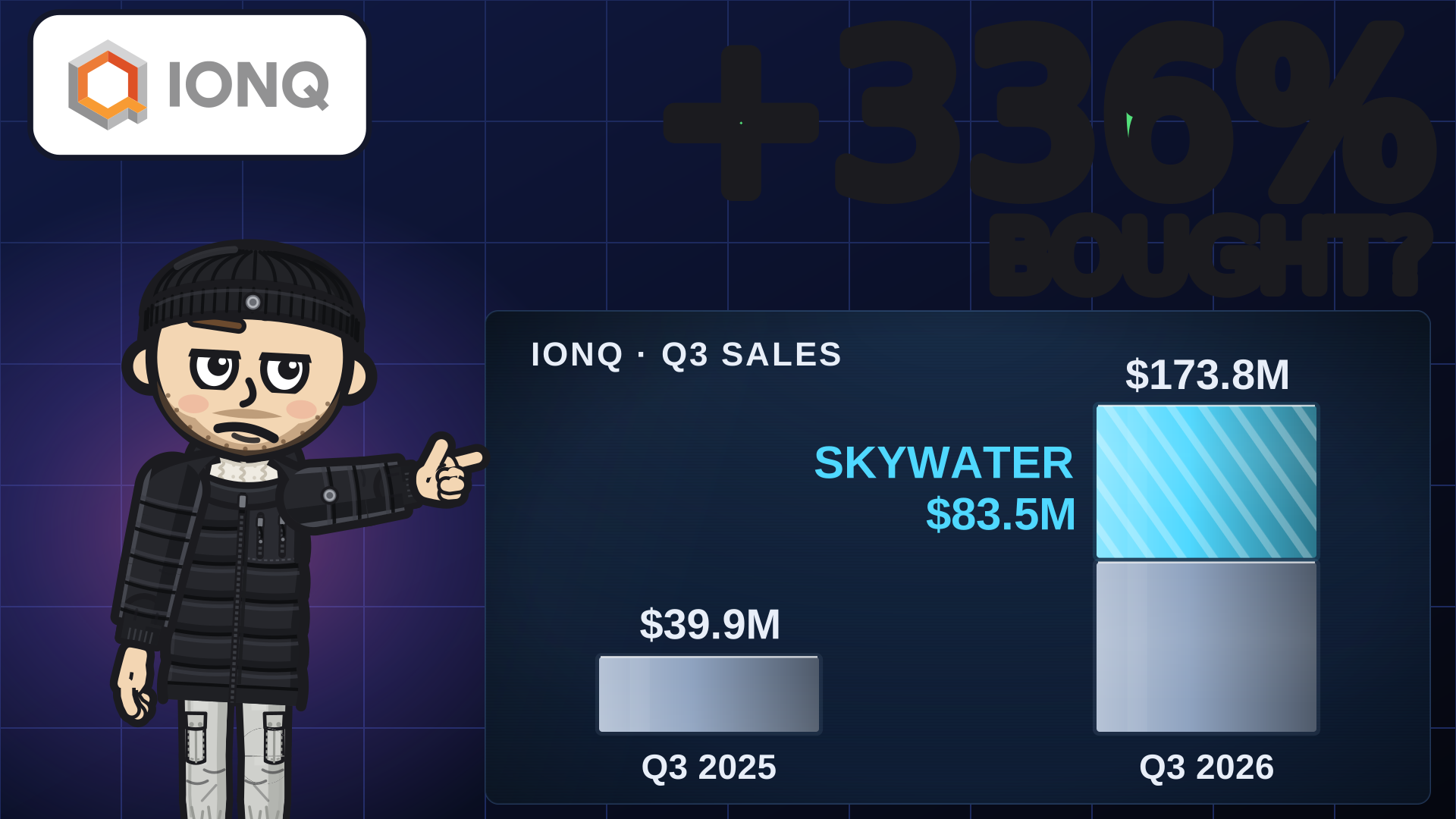 HYPE FUND #6 · $IONQ
IonQ Made $564 Million Because Its Stock Fell. Wait, What?
IonQ lost $433 million running its business in the third quarter and reported a $564 million profit, because its stock fell. Gus counted what $32.62 a share needs: 32% more sales a year for four years, none of it bought.
 HYPE CHECK #2 · $RDDT
Reddit (RDDT): Who Needs Enemies With Friends Like Google?
Reddit grew 53% and the stock fell 29% the next day. Google's AI summaries keep the click, and Reddit answers with a login wall. Gus read the filings.
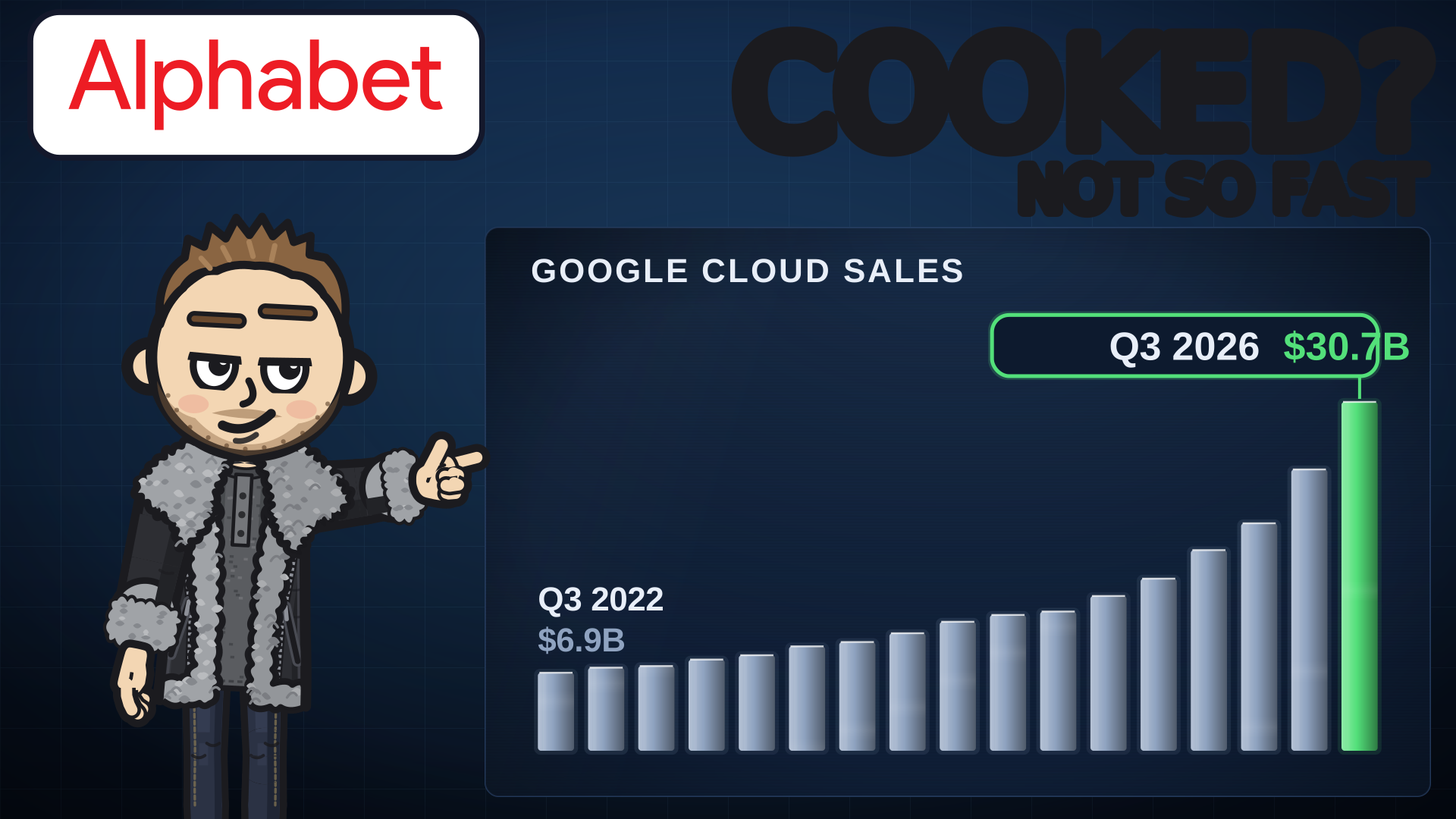 HYPE FUND #5 · $GOOGL
$482 Billion Gone in a Day. Is Google Cooked? (Not So Fast)
Alphabet is betting $195 to $205 billion this year on five horses: chip, model, cloud, the way it reaches users, and data centers. Is it enough if only some of them win? Gus did the math against the S&P 500.
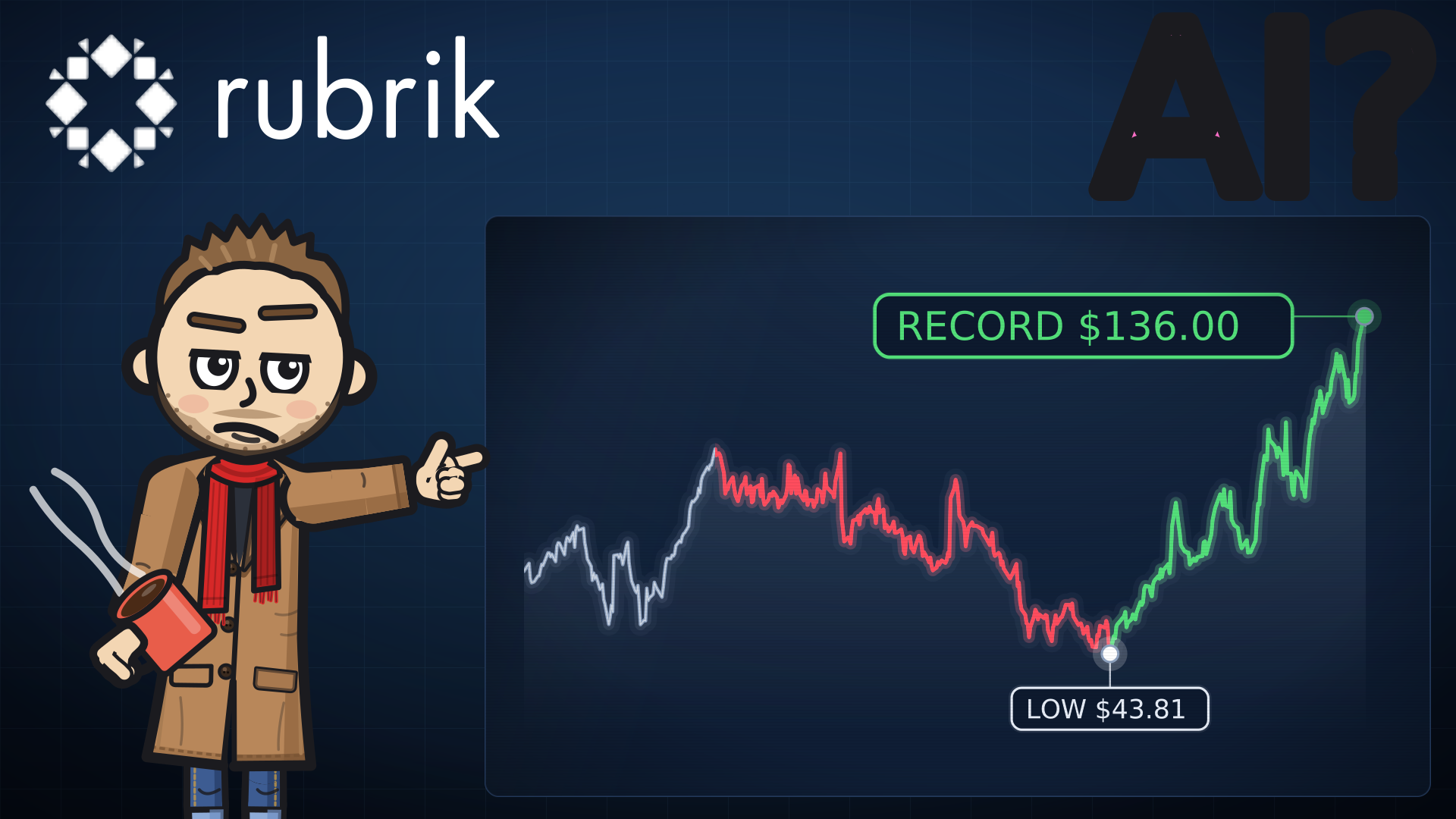 HYPE CHECK #1 · $RBRK
Rubrik Stock (RBRK) Up 210% Since April. Just Backup?
Up 210% since April. It calls itself "the Security and AI Operations Company," and its AI product has "over 15" customers. Gus checked what's under the label.
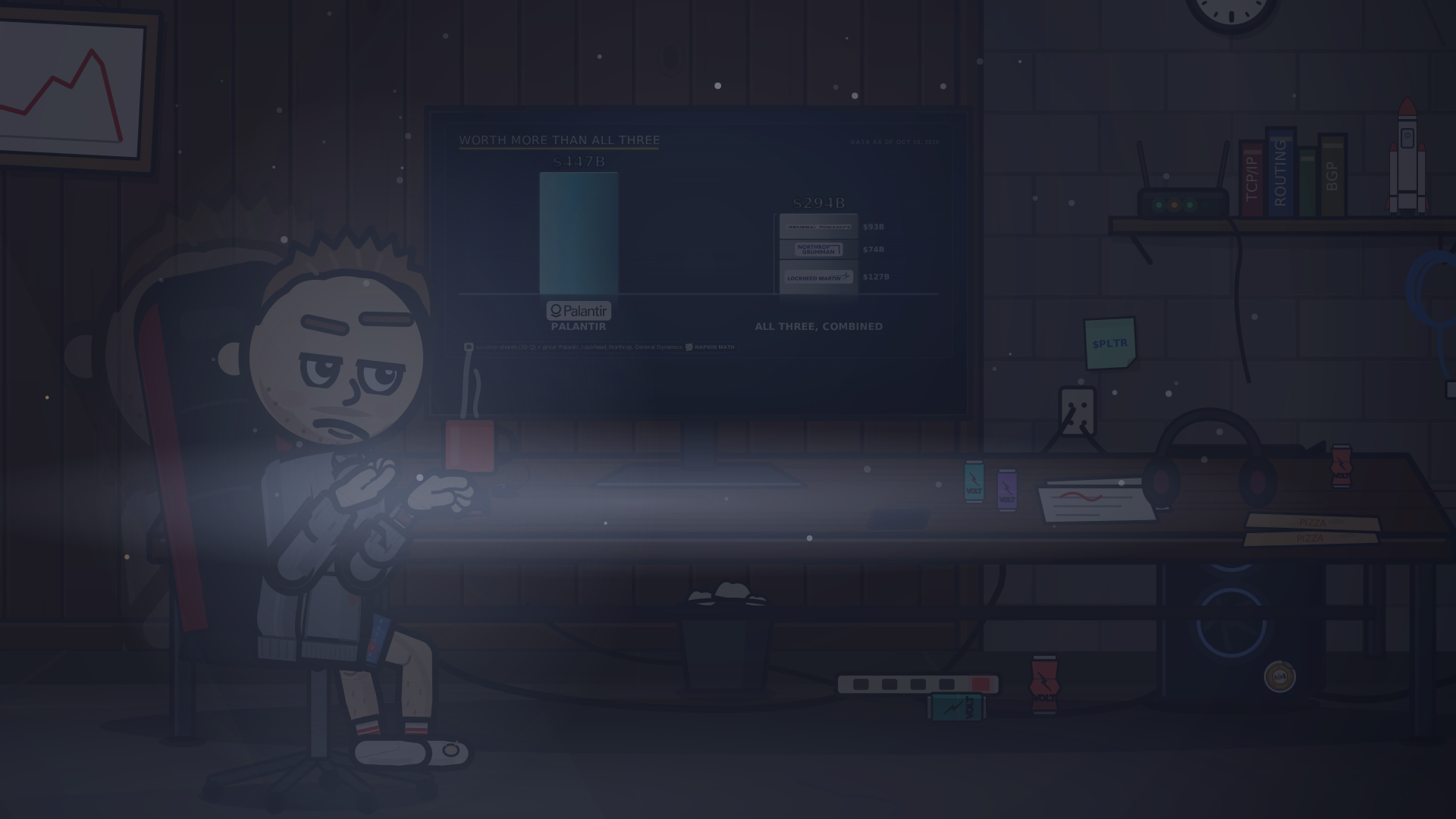 HYPE FUND #3 · $PLTR
Too late to buy Palantir stock? The math behind $38 billion
Karp's goal: $38 billion in sales by 2030. Say he gets there. What's a Palantir share worth then, and does it beat an index fund? Gus did the math.
 HYPE FUND #2 · $SPCX
SpaceX stock: what are you paying $2 trillion for?
Only Starlink makes an operating profit. Last quarter the AI build cost $174 million a day. Musk says the AI satellites launch "next year."
 HYPE FUND #1 · $MU
Micron: the cheapest stock ever?
Micron is up 270% in 2026. Social media: "cheapest stock in all stock exchanges." Cheap is a number. Gus looked it up.
Chapters
- 0:00Broadcom's AI sales tripled. The stock fell 33%
- 1:18What is Broadcom? Custom AI chips, Google's TPU and Broadcom's customers
- 2:46Stop one: Broadcom's P/E vs Nvidia, and what the price counts on
- 15:19Stop two: Broadcom's customers. Alphabet, Amazon, Microsoft, Meta, Oracle
- 21:00Stop three: who pays? Anthropic, OpenAI and Lucent in 2000
- 29:00Stop four: the profit. Margins, memory and VMware renewals
- 35:50Broadcom stock prediction: what has to be true for you to make money on AVGO
- 37:42The bull case: Broadcom's $230 billion plan
- 39:41The Hype Fund
- 40:33To the moon
Mentioned in the video
- BroadcomThe company (AVGO): custom AI chips, network chips, VMware
- Hock TanBroadcom's CEO; earnings calls, Bloomberg, CNBC
- NvidiaThe P/E next to Broadcom's; commitments, the OpenAI guarantee, 2022
- TSMCMakes most of Broadcom's chips
- Google and AlphabetCustomer (the TPU); one of the five builders
- MetaCustomer; one of the five builders
- AnthropicCustomer; the guarantee and the loan; the coming listing
- OpenAICustomer; ten gigawatts on a term sheet
- VMwareBroadcom's software; the renewals
- AmazonOne of the five builders
- MicrosoftOne of the five builders
- OracleOne of the five builders
- ApolloBuys the racks and rents them to Anthropic
- McKinseyThe state of AI, 2026: 37% see a profit from AI
- LucentCustomer financing in 2000; sales −57.37% by 2002
- NortelSales −62.22%, 2000 to 2002
- AristaBuilds switches on Broadcom's chips
- MediaTekMakes a version of Google's TPU too
- AT&TTook Broadcom to court over VMware
- BloombergHock Tan, June 2026
- ReutersThe $42 billion loan, from Anthropic's draft filing
Sources & links
Primary sources (SEC filings, company transcripts, the papers themselves) come first where they exist. "Secondary" means another site's report of it. Each group has a fixed link, e.g. #sources-hook.
The price 0:00
- 10-Q, Q3 fiscal 2026: sales by business, AI sales, contracts, purchase commitments, the guarantee and the loan
sec.gov/Archives/edgar/data/173016…0080/avgo-20260802.htm - AVGO daily closes (price on Oct 23, 2026: $321.68)
query1.finance.yahoo.com/v8/finance/chart/AVGO - Hock Tan on Bloomberg Tech: "stop thinking about your stock price"
youtube.com/watch?v=CaK1eNKF9nY
What Gus read 0:29
What Broadcom is 1:18
- 10-K, fiscal 2025: the business, the risks, customer pressure on pricing
sec.gov/Archives/edgar/data/173016…0121/avgo-20251102.htm - Earnings release, Q3 fiscal 2026: AI sales, the Q4 forecast of $21.7 billion
sec.gov/Archives/edgar/data/173016…o-08022026x8kxex99.htm - Q1 fiscal 2025 call: "we are not really the creator of those XPUs"
youtube.com/watch?v=eNr0qf8XJ8E
Stop one: the price 2:46
- P/E of big chip companies, 2010 to 2026 (Gus's count; Broadcom's page, other chipmakers the same way)
data.sec.gov/api/xbrl/companyfacts/CIK0001730168.json - Nvidia 10-Q, Q2 fiscal 2027: profit, gains on other companies' stock, contracts, commitments
sec.gov/Archives/edgar/data/104581…0075/nvda-20260726.htm - Earnings release, Q2 fiscal 2026: the June AI forecast
sec.gov/Archives/edgar/data/173016…o-05032026x8kxex99.htm - Earnings release, Q4 fiscal 2025: the 15th dividend increase in a row
sec.gov/Archives/edgar/data/173016…o-11022025x8kxex99.htm - 10-Q, Q1 fiscal 2026: the global minimum tax "materially increased" Broadcom's tax; customer tooling as a new risk
sec.gov/Archives/edgar/data/173016…0016/avgo-20260201.htm - Q4 fiscal 2024 call: a market of $60 to $90 billion in 2027
youtube.com/watch?v=PlAWrZ48ow4 - Q2 fiscal 2025 call: "I think you're doing the math. I'm giving you the trend."
youtube.com/watch?v=eQo2JNlXYeM - Q4 fiscal 2025 call: $73 billion of AI orders; lead time six months to a year
youtube.com/watch?v=SpCQFkj9b0s - Q2 fiscal 2026 call: over $30 billion of AI orders in the quarter
youtube.com/watch?v=1faLITatfNQ - Generative AI reshapes the processor market: AI chip forecasts to 2030
yolegroup.com/press-release/genera…-unprecedented-growth/
Stop two: the customers 15:19
- The five builders' filings: spending on buildings and equipment, cash, debt
sec.gov/Archives/edgar/data/165204…0071/goog-20260630.htm · Amazon · Microsoft · Meta · Oracle - Their calls: Alphabet "increase significantly", Microsoft "will grow", Meta "continue investing aggressively"
youtube.com/watch?v=LzExSq9DU9w · Microsoft · Meta - Amazon Q2 2026 call: AI capacity "contracted for at least five year terms"
s2.q4cdn.com/299287126/files/doc_e…-2026-Full-Call-v1.mp3 - The state of AI in 2026: 37% report AI added to profit
mckinsey.com/capabilities/quantumb…sights/the-state-of-ai - US private investment in communication equipment, 2000 to 2002
fred.stlouisfed.org/graph/fredgraph.csv?id=C275RC1A027NBEA - Lucent 10-K, fiscal 2002: sales 1998 to 2002
sec.gov/Archives/edgar/data/100624…5011702003045/ex13.htm - Nortel 10-K, 2002: sales 2000 to 2002
sec.gov/Archives/edgar/data/72911/…000343/t09107e10vk.htm - Ethernet switch market, Q2 2026: Nvidia the biggest brand in data center switches, 20.4%
idc.com/resource-center/blog/ether…d-datacenter-spending/
Stop three: who pays? 21:00
- 10-Q, Q2 fiscal 2026: the Apollo racks and the guarantee of up to $29 billion
sec.gov/Archives/edgar/data/173016…0054/avgo-20260503.htm - Broadcom to lend Anthropic up to $42 billion, filing says
thestar.com.my/tech/tech-news/2026…-its-chips-filing-says - Nvidia 10-K, fiscal 2023: the charge when the cycle turned in 2022
sec.gov/Archives/edgar/data/104581…0017/nvda-20230129.htm - Lucent 10-K, fiscal 2001: customer financing of $8.1 billion
sec.gov/Archives/edgar/data/100624…11701501896/a31752.txt - Anthropic expands use of Google Cloud and TPUs: chips through Broadcom and Google Cloud
googlecloudpresscorner.com/2026-04…-Google-Cloud-and-TPUs - Broadcom 8-K: Google and Anthropic
sec.gov/Archives/edgar/data/173016…26144028/d87999d8k.htm - OpenAI and Broadcom announce a collaboration to deploy 10 gigawatts
investors.broadcom.com/news-releas…ollaboration-deploy-10 - Q3 fiscal 2026 call: the supply, the six customers, financing for two, Anthropic's gigawatts, $20 to $30 billion per gigawatt
youtube.com/watch?v=MBoen7IrrFU - Hock Tan on Mad Money: "cash flow poor, but they are valuation rich"
youtube.com/watch?v=7r1mfWVFfqk
Stop four: the profit 29:00
- AI server ASIC shipments to triple by 2027: memory and the markup
counterpointresearch.com/en/insigh…ents-to-Triple-by-2027 - MediaTek's AI chip business
counterpointresearch.com/en/insigh…pute-Shipments-in-2028 - Q1 fiscal 2026 call: "It will come eventually"
youtube.com/watch?v=EtmPmQlHVO8 - AT&T and Broadcom in court over VMware prices
ciodive.com/news/att-broadcom-vmwa…s-court-battle/728603/ - Q3 fiscal 2025 call: "Stay tuned. I'll let you know."
youtube.com/watch?v=Fv-lz1GsQVo
What has to be true, and the buy 35:50
- Q3 fiscal 2026 call: $230 billion in fiscal 2028; the next report on December 9, 2026
youtube.com/watch?v=MBoen7IrrFU - The Hype Fund: every stock and its entry price
The Hype Fund page - Music and sound effects credits
Everything we read
The whole pile behind the episode, in the same counts the video gives.
SEC filings 43
- 10-K, FY2019
sec.gov/Archives/edgar/data/173016…/avgo-11032019x10k.htm - 10-K, FY2020
sec.gov/Archives/edgar/data/173016…01730168-20-000226.txt - 10-K, FY2021
sec.gov/Archives/edgar/data/173016…0153/avgo-20211031.htm - 10-K, FY2022
sec.gov/Archives/edgar/data/173016…0118/avgo-20221030.htm - 8-K, earnings release, Q4 FY2022
sec.gov/Archives/edgar/data/173016…o-10302022x8kxex99.htm - 10-Q, Q1 FY2023
sec.gov/Archives/edgar/data/173016…0008/avgo-20230129.htm - 8-K, earnings release, Q1 FY2023
sec.gov/Archives/edgar/data/173016…o-01292023x8kxex99.htm - 10-Q, Q2 FY2023
sec.gov/Archives/edgar/data/173016…0064/avgo-20230430.htm - 8-K, earnings release, Q2 FY2023
sec.gov/Archives/edgar/data/173016…o-04302023x8kxex99.htm - 10-Q, Q3 FY2023
sec.gov/Archives/edgar/data/173016…0077/avgo-20230730.htm - 8-K, earnings release, Q3 FY2023
sec.gov/Archives/edgar/data/173016…o-07302023x8kxex99.htm - 10-K, FY2023
sec.gov/Archives/edgar/data/173016…0096/avgo-20231029.htm - 8-K, earnings release, Q4 FY2023
sec.gov/Archives/edgar/data/173016…o-10292023x8kxex99.htm - 10-Q, Q1 FY2024
sec.gov/Archives/edgar/data/173016…0023/avgo-20240204.htm - 8-K, earnings release, Q1 FY2024
sec.gov/Archives/edgar/data/173016…o-02042024x8kxex99.htm - 10-Q, Q2 FY2024
sec.gov/Archives/edgar/data/173016…0080/avgo-20240505.htm - 8-K, earnings release, Q2 FY2024
sec.gov/Archives/edgar/data/173016…o-05052024x8kxex99.htm - 10-Q, Q3 FY2024
sec.gov/Archives/edgar/data/173016…0099/avgo-20240804.htm - 8-K, earnings release, Q3 FY2024
sec.gov/Archives/edgar/data/173016…o-08042024x8kxex99.htm - 10-K, FY2024
sec.gov/Archives/edgar/data/173016…0139/avgo-20241103.htm - 8-K, earnings release, Q4 FY2024
sec.gov/Archives/edgar/data/173016…o-11032024x8kxex99.htm - 10-Q, Q1 FY2025
sec.gov/Archives/edgar/data/173016…0021/avgo-20250202.htm - 8-K, earnings release, Q1 FY2025
sec.gov/Archives/edgar/data/173016…o-02022025x8kxex99.htm - 10-Q, Q2 FY2025
sec.gov/Archives/edgar/data/173016…0064/avgo-20250504.htm - 8-K, earnings release, Q2 FY2025
sec.gov/Archives/edgar/data/173016…o-05042025x8kxex99.htm - 10-Q, Q3 FY2025
sec.gov/Archives/edgar/data/173016…0098/avgo-20250803.htm - 8-K, earnings release, Q3 FY2025
sec.gov/Archives/edgar/data/173016…o-08032025x8kxex99.htm - 10-K, FY2025
sec.gov/Archives/edgar/data/173016…0121/avgo-20251102.htm - 8-K, earnings release, Q4 FY2025
sec.gov/Archives/edgar/data/173016…o-11022025x8kxex99.htm - 8-K, 2025
sec.gov/Archives/edgar/data/173016…25199281/d58273d8k.htm - 10-Q, Q1 FY2026
sec.gov/Archives/edgar/data/173016…0016/avgo-20260201.htm - 8-K, earnings release, Q1 FY2026
sec.gov/Archives/edgar/data/173016…o-02012026x8kxex99.htm - 10-Q, Q2 FY2026
sec.gov/Archives/edgar/data/173016…0054/avgo-20260503.htm - 8-K, earnings release, Q2 FY2026
sec.gov/Archives/edgar/data/173016…o-05032026x8kxex99.htm - 10-Q, Q3 FY2026
sec.gov/Archives/edgar/data/000173…0080/avgo-20260802.htm - 8-K, earnings release, Q3 FY2026
sec.gov/Archives/edgar/data/000173…o-08022026x8kxex99.htm - 8-K, 2026
sec.gov/Archives/edgar/data/173016…6140574/d109450d8k.htm - 8-K, 2026
sec.gov/Archives/edgar/data/173016…26144028/d87999d8k.htm - 8-K, 2026
sec.gov/Archives/edgar/data/173016…6266777/d152717d8k.htm - 8-K, 2026
sec.gov/Archives/edgar/data/173016…6275077/d149683d8k.htm - 8-K, 2026
sec.gov/Archives/edgar/data/173016…26295589/d84378d8k.htm - S-4, 2026
sec.gov/Archives/edgar/data/173016…6387881/d154803ds4.htm - 424B3 prospectus, 2026
sec.gov/Archives/edgar/data/173016…5593/d154803d424b3.htm
Earnings calls 8
- Q4 FY2024 earnings call
youtube.com/watch?v=PlAWrZ48ow4 - Q1 FY2025 earnings call
youtube.com/watch?v=eNr0qf8XJ8E - Q2 FY2025 earnings call
youtube.com/watch?v=eQo2JNlXYeM - Q3 FY2025 earnings call
youtube.com/watch?v=Fv-lz1GsQVo - Q4 FY2025 earnings call
youtube.com/watch?v=SpCQFkj9b0s - Q1 FY2026 earnings call
youtube.com/watch?v=EtmPmQlHVO8 - Q2 FY2026 earnings call
youtube.com/watch?v=1faLITatfNQ - Q3 FY2026 earnings call
youtube.com/watch?v=MBoen7IrrFU
Research links 1,253
Broadcom's filings 54
- data.sec.gov/api/xbrl/companyfacts/CIK0001730168.json
- data.sec.gov/submissions/CIK0001730168.json
- efts.sec.gov/LATEST/search-index?c…01730168&forms=CORRESP
- efts.sec.gov/LATEST/search-index?q…01730168&forms=CORRESP
- finance.yahoo.com/news/broadcom-ti…plosive-094318014.html
- resources.glasslewis.com/hubfs/Sam…25%20Proxy%20Paper.pdf
- semiwiki.com/forum/threads/im-havi…and-projections.24678/
- trading-treff.de/trading/broadcom-…pay-spaltet-aktionaere
- bloomberg.com/news/articles/2025-0…hes-2030-ai-sales-goal
- sec.gov/Archives/edgar/data/000173…0039/avgo-20260420.htm
- sec.gov/Archives/edgar/data/173016…24001163/filename1.pdf
- sec.gov/Archives/edgar/data/173016…24002764/filename1.pdf
- sec.gov/Archives/edgar/data/173016…25199281/d58273d8k.htm
- sec.gov/Archives/edgar/data/173016…99281/d58273dex101.htm
- sec.gov/Archives/edgar/data/173016…25206026/filename1.htm
- sec.gov/Archives/edgar/data/173016…5691/d49254ddef14a.htm
- sec.gov/Archives/edgar/data/173016…6140574/d109450d8k.htm
- sec.gov/Archives/edgar/data/173016…o-10302022x8kxex99.htm
- sec.gov/Archives/edgar/data/173016…0118/avgo-20221030.htm
- sec.gov/Archives/edgar/data/173016…o-01292023x8kxex99.htm
- sec.gov/Archives/edgar/data/173016…0008/avgo-20230129.htm
- sec.gov/Archives/edgar/data/173016…o-04302023x8kxex99.htm
- sec.gov/Archives/edgar/data/173016…0064/avgo-20230430.htm
- sec.gov/Archives/edgar/data/173016…o-07302023x8kxex99.htm
- sec.gov/Archives/edgar/data/173016…0077/avgo-20230730.htm
- sec.gov/Archives/edgar/data/173016…o-10292023x8kxex99.htm
- sec.gov/Archives/edgar/data/173016…0096/avgo-20231029.htm
- sec.gov/Archives/edgar/data/173016…24000007/filename1.htm
- sec.gov/Archives/edgar/data/173016…o-02042024x8kxex99.htm
- sec.gov/Archives/edgar/data/173016…24000013/filename1.htm
- sec.gov/Archives/edgar/data/173016…0023/avgo-20240204.htm
- sec.gov/Archives/edgar/data/173016…o-05052024x8kxex99.htm
- sec.gov/Archives/edgar/data/173016…0080/avgo-20240505.htm
- sec.gov/Archives/edgar/data/173016…o-08042024x8kxex99.htm
- sec.gov/Archives/edgar/data/173016…0099/avgo-20240804.htm
- sec.gov/Archives/edgar/data/173016…o-11032024x8kxex99.htm
- sec.gov/Archives/edgar/data/173016…0139/avgo-20241103.htm
- sec.gov/Archives/edgar/data/173016…o-02022025x8kxex99.htm
- sec.gov/Archives/edgar/data/173016…0021/avgo-20250202.htm
- sec.gov/Archives/edgar/data/173016…o-05042025x8kxex99.htm
- sec.gov/Archives/edgar/data/173016…0064/avgo-20250504.htm
- sec.gov/Archives/edgar/data/173016…o-08032025x8kxex99.htm
- sec.gov/Archives/edgar/data/173016…0098/avgo-20250803.htm
- sec.gov/Archives/edgar/data/173016…o-11022025x8kxex99.htm
- sec.gov/Archives/edgar/data/173016…0121/avgo-20251102.htm
- sec.gov/Archives/edgar/data/173016…o-02012026x8kxex99.htm
- sec.gov/Archives/edgar/data/173016…0016/avgo-20260201.htm
- sec.gov/Archives/edgar/data/173016…o-05032026x8kxex99.htm
- sec.gov/Archives/edgar/data/173016…0054/avgo-20260503.htm
- sec.gov/Archives/edgar/data/1730168/000173016826000076/
- sec.gov/Archives/edgar/data/173016…o-08022026x8kxex99.htm
- sec.gov/Archives/edgar/data/173016…0080/avgo-20260802.htm
- sec.gov/files/rules/interp/2020/33-10751.pdf
Earnings calls and quotes 39
- abc.xyz/investor/
- abc.xyz/investor/news/news-details…tpGZsLS6v/default.aspx
- ciodive.com/news/amazon-adds-200b-ai-buildout-rush/811633
- data.sec.gov/submissions/CIK0000789019.json
- data.sec.gov/submissions/CIK0001018724.json
- data.sec.gov/submissions/CIK0001326801.json
- data.sec.gov/submissions/CIK0001652044.json
- investors.broadcom.com/company-inf…n/events-presentations
- investors.broadcom.com/financial-i…inancial-news-releases
- investors.broadcom.com/financial-i…tion/quarterly-results
- investors.broadcom.com/news-releases
- ir.aboutamazon.com/events/default.aspx
- ir.aboutamazon.com/news-release/ne…ence-Call/default.aspx
- news.microsoft.com/source/?s=quarterly+earnings+release+date
- news.microsoft.com/source/2026/10/…nings-release-date-69/
- datacenterdynamics.com/en/news/ama…fund-aws-data-centers/
- geekwire.com/2026/amazon-stock-sin…b-in-capital-spending/
- microsoft.com/en-us/investor/events/default
- microsoft.com/en-us/investor/events/events-upcoming
- sec.gov/Archives/edgar/data/132680…28026066700/index.json
- sec.gov/Archives/edgar/data/132680…9302026xexhibit991.htm
- sec.gov/Archives/edgar/data/173016…16826000076/index.json
- youtube.com/watch?v=1faLITatfNQ
- youtube.com/watch?v=7r1mfWVFfqk
- youtube.com/watch?v=ADOeIXwqDvs
- youtube.com/watch?v=CaK1eNKF9nY
- youtube.com/watch?v=eNr0qf8XJ8E
- youtube.com/watch?v=eQo2JNlXYeM
- youtube.com/watch?v=EtmPmQlHVO8
- youtube.com/watch?v=fDAMcvbES_A
- youtube.com/watch?v=Fv-lz1GsQVo
- youtube.com/watch?v=lBTEcnw7Sgs
- youtube.com/watch?v=LzExSq9DU9w
- youtube.com/watch?v=MBoen7IrrFU
- youtube.com/watch?v=PlAWrZ48ow4
- youtube.com/watch?v=pU2HhJ3jCts
- youtube.com/watch?v=SpCQFkj9b0s
- youtube.com/watch?v=th4ByUph3mg
- youtube.com/watch?v=TMXwTewpwmo
The acquisitions under Hock Tan 268
- competition-cases.ec.europa.eu/cases/M.10806
- data.sec.gov/api/xbrl/companyfacts/CIK0000356028.json
- data.sec.gov/api/xbrl/companyfacts/CIK0000703360.json
- data.sec.gov/api/xbrl/companyfacts/CIK0000849399.json
- data.sec.gov/api/xbrl/companyfacts/CIK0001009304.json
- data.sec.gov/api/xbrl/companyfacts/CIK0001054374.json
- data.sec.gov/api/xbrl/companyfacts/CIK0001124610.json
- data.sec.gov/api/xbrl/companyfacts/CIK0001441634.json
- data.sec.gov/api/xbrl/companyfacts/CIK0001649338.json
- data.sec.gov/submissions/CIK0000804328-submissions-001.json
- data.sec.gov/submissions/CIK0000804328-submissions-002.json
- data.sec.gov/submissions/CIK0000804328-submissions-003.json
- data.sec.gov/submissions/CIK0000804328.json
- data.sec.gov/submissions/CIK0000849399.json
- data.sec.gov/submissions/CIK0001211588.json
- data.sec.gov/submissions/CIK0001441634.json
- data.sec.gov/submissions/CIK0001649338.json
- ec.europa.eu/commission/presscorne…IP/23/3727&language=en
- ec.europa.eu/commission/presscorner/detail/en/ip_23_3727
- ec.europa.eu/commission/presscorner/detail/en/ip_23_3777
- news.broadcom.com/news/
- news.broadcom.com/news/vmware-by-b…usiness-transformation
- channelfutures.com/channel-busines…ware-questions-head-on
- federalregister.gov/documents/2018…ed-by-broadcom-limited
- govinfo.gov/content/pkg/FR-2018-03-15/html/2018-05479.htm
- sec.gov/Archives/edgar/data/112461…00015/vmw-20230203.htm
- sec.gov/Archives/edgar/data/121158…477/dp206931_4-tan.xml
- sec.gov/Archives/edgar/data/121158…852/dp211237_4-tan.xml
- sec.gov/Archives/edgar/data/121158…592/dp213033_4-tan.xml
- sec.gov/Archives/edgar/data/121158…407/dp216703_4-tan.xml
- sec.gov/Archives/edgar/data/121158…532/dp220725_4-tan.xml
- sec.gov/Archives/edgar/data/121158…196/dp225015_4-tan.xml
- sec.gov/Archives/edgar/data/121158…200/dp228829_4-tan.xml
- sec.gov/Archives/edgar/data/121158…633/dp230348_4-tan.xml
- sec.gov/Archives/edgar/data/121158…484/dp232996_4-tan.xml
- sec.gov/Archives/edgar/data/121158…962/dp237384_4-tan.xml
- sec.gov/Archives/edgar/data/121158…350/dp241666_4-tan.xml
- sec.gov/Archives/edgar/data/121158…26007464/ownership.xml
- sec.gov/Archives/edgar/data/121158…4036115011484/doc1.xml
- sec.gov/Archives/edgar/data/121158…4036115011759/doc1.xml
- sec.gov/Archives/edgar/data/121158…4036116050124/doc1.xml
- sec.gov/Archives/edgar/data/121158…4036116050157/doc1.xml
- sec.gov/Archives/edgar/data/121158…k-form4_1766442523.xml
- sec.gov/Archives/edgar/data/121158…m4_138879845302440.xml
- sec.gov/Archives/edgar/data/121158…m4_139475780054003.xml
- sec.gov/Archives/edgar/data/121158…m4_143389539343764.xml
- sec.gov/Archives/edgar/data/121158…m4_143622559932265.xml
- sec.gov/Archives/edgar/data/121158…m4_143881807661361.xml
- sec.gov/Archives/edgar/data/121158…m4_144131580061641.xml
- sec.gov/Archives/edgar/data/121158…m4_144408039167372.xml
- sec.gov/Archives/edgar/data/121158…m4_144659747091871.xml
- sec.gov/Archives/edgar/data/121158…m4_144918396692982.xml
- sec.gov/Archives/edgar/data/121158…m4_144987002387830.xml
- sec.gov/Archives/edgar/data/121158…m4_145203897052309.xml
- sec.gov/Archives/edgar/data/121158…m4_140995960257064.xml
- sec.gov/Archives/edgar/data/121158…m4_145774081601872.xml
- sec.gov/Archives/edgar/data/121158…m4_148123981731542.xml
- sec.gov/Archives/edgar/data/121158…m4_148902121619199.xml
- sec.gov/Archives/edgar/data/121158…m4_148910011518312.xml
- sec.gov/Archives/edgar/data/121158…m4_148970503684496.xml
- sec.gov/Archives/edgar/data/121158…m4_150585728369951.xml
- sec.gov/Archives/edgar/data/121158…m4_150828216559018.xml
- sec.gov/Archives/edgar/data/121158…m4_151095898640037.xml
- sec.gov/Archives/edgar/data/121158…m4_151373050320459.xml
- sec.gov/Archives/edgar/data/121158…m4_151632188897237.xml
- sec.gov/Archives/edgar/data/121158…m4_151916520711383.xml
- sec.gov/Archives/edgar/data/121158…m4_152123683168292.xml
- sec.gov/Archives/edgar/data/121158…m4_152408761790918.xml
- sec.gov/Archives/edgar/data/121158…m4_152659368323756.xml
- sec.gov/Archives/edgar/data/121158…m4_152944397670265.xml
- sec.gov/Archives/edgar/data/121158…m4_153194981317429.xml
- sec.gov/Archives/edgar/data/121158…m4_153454113330101.xml
- sec.gov/Archives/edgar/data/121158…m4_153739379659457.xml
- sec.gov/Archives/edgar/data/121158…m4_153981107541202.xml
- sec.gov/Archives/edgar/data/121158…m4_154267003854158.xml
- sec.gov/Archives/edgar/data/121158…m4_154525927137391.xml
- sec.gov/Archives/edgar/data/121158…m4_154776519305406.xml
- sec.gov/Archives/edgar/data/121158…m4_155070084348546.xml
- sec.gov/Archives/edgar/data/121158…m4_155303821900270.xml
- sec.gov/Archives/edgar/data/121158…m4_155553589537706.xml
- sec.gov/Archives/edgar/data/121158…m4_155812884665400.xml
- sec.gov/Archives/edgar/data/121158…m4_156097773922074.xml
- sec.gov/Archives/edgar/data/121158…m4_156115357575086.xml
- sec.gov/Archives/edgar/data/121158…m4_156339989025613.xml
- sec.gov/Archives/edgar/data/121158…m4_156625071630789.xml
- sec.gov/Archives/edgar/data/121158…m4_156884140826645.xml
- sec.gov/Archives/edgar/data/121158…m4_157134695977021.xml
- sec.gov/Archives/edgar/data/121158…m4_157420060087257.xml
- sec.gov/Archives/edgar/data/121158…m4_157670915660671.xml
- sec.gov/Archives/edgar/data/121158…m4_157869474358617.xml
- sec.gov/Archives/edgar/data/121158…m4_157929794531101.xml
- sec.gov/Archives/edgar/data/121158…m4_157990382042313.xml
- sec.gov/Archives/edgar/data/121158…m4_158154551744322.xml
- sec.gov/Archives/edgar/data/121158…m4_158223970043538.xml
- sec.gov/Archives/edgar/data/121158…m4_158275482057070.xml
- sec.gov/Archives/edgar/data/121158…m4_158396041986941.xml
- sec.gov/Archives/edgar/data/121158…m4_158457863111625.xml
- sec.gov/Archives/edgar/data/121158…m4_159251467213961.xml
- sec.gov/Archives/edgar/data/121158…m4_159259920986345.xml
- sec.gov/Archives/edgar/data/121158…m4_159312093003474.xml
- sec.gov/Archives/edgar/data/121158…m4_159372308671372.xml
- sec.gov/Archives/edgar/data/121158…m4_159432863556777.xml
- sec.gov/Archives/edgar/data/121158…m4_159493273331152.xml
- sec.gov/Archives/edgar/data/121158…m4_159553684382935.xml
- sec.gov/Archives/edgar/data/121158…m4_159615257128454.xml
- sec.gov/Archives/edgar/data/121158…m4_159674722739012.xml
- sec.gov/Archives/edgar/data/121158…m4_159735352344456.xml
- sec.gov/Archives/edgar/data/121158…m4_159795446070862.xml
- sec.gov/Archives/edgar/data/121158…m4_159856000879557.xml
- sec.gov/Archives/edgar/data/121158…m4_159916868635364.xml
- sec.gov/Archives/edgar/data/121158…m4_159977308953726.xml
- sec.gov/Archives/edgar/data/121158…m4_160037575920195.xml
- sec.gov/Archives/edgar/data/121158…m4_160158467486748.xml
- sec.gov/Archives/edgar/data/121158…m4_160262173863700.xml
- sec.gov/Archives/edgar/data/121158…m4_160279561146134.xml
- sec.gov/Archives/edgar/data/121158…m4_160400455888131.xml
- sec.gov/Archives/edgar/data/121158…m4_160521764811863.xml
- sec.gov/Archives/edgar/data/121158…m4_160651336945444.xml
- sec.gov/Archives/edgar/data/121158…m4_160764155338181.xml
- sec.gov/Archives/edgar/data/121158…m4_160824388361085.xml
- sec.gov/Archives/edgar/data/121158…m4_160858786829232.xml
- sec.gov/Archives/edgar/data/121158…m4_160919298714100.xml
- sec.gov/Archives/edgar/data/121158…m4_162430986932124.xml
- sec.gov/Archives/edgar/data/121158…m5_163675249004206.xml
- sec.gov/Archives/edgar/data/121158…m4_166743426279865.xml
- sec.gov/Archives/edgar/data/121158…m4_166855126107882.xml
- sec.gov/Archives/edgar/data/121158…m4_167934922138697.xml
- sec.gov/Archives/edgar/data/121158…k-form4_1688079891.xml
- sec.gov/Archives/edgar/data/121158…k-form4_1699397389.xml
- sec.gov/Archives/edgar/data/121158…k-form4_1702939989.xml
- sec.gov/Archives/edgar/data/121158…k-form4_1703291994.xml
- sec.gov/Archives/edgar/data/121158…k-form4_1704751320.xml
- sec.gov/Archives/edgar/data/121158…k-form4_1712011688.xml
- sec.gov/Archives/edgar/data/121158…k-form4_1712267119.xml
- sec.gov/Archives/edgar/data/121158…k-form4_1719351039.xml
- sec.gov/Archives/edgar/data/121158…k-form4_1720561595.xml
- sec.gov/Archives/edgar/data/121158…k-form4_1721079004.xml
- sec.gov/Archives/edgar/data/121158…k-form4_1726780576.xml
- sec.gov/Archives/edgar/data/121158…k-form4_1727384760.xml
- sec.gov/Archives/edgar/data/121158…k-form4_1727989752.xml
- sec.gov/Archives/edgar/data/121158…k-form4_1728334718.xml
- sec.gov/Archives/edgar/data/121158…k-form4_1731110093.xml
- sec.gov/Archives/edgar/data/121158…k-form4_1735340348.xml
- sec.gov/Archives/edgar/data/121158…k-form4_1750116498.xml
- sec.gov/Archives/edgar/data/121158…k-form4_1750885780.xml
- sec.gov/Archives/edgar/data/121158…k-form4_1751317844.xml
- sec.gov/Archives/edgar/data/121158…k-form4_1757711350.xml
- sec.gov/Archives/edgar/data/121158…-form4a_1757982812.xml
- sec.gov/Archives/edgar/data/121158…k-form4_1758837328.xml
- sec.gov/Archives/edgar/data/121158…k-form4_1767047467.xml
- sec.gov/Archives/edgar/data/121158…k-form4_1767915448.xml
- sec.gov/Archives/edgar/data/121158…k-form4_1775861306.xml
- sec.gov/Archives/edgar/data/144163…3473952/d644862d8k.htm
- sec.gov/Archives/edgar/data/144163…3952/d644862dex991.htm
- sec.gov/Archives/edgar/data/144163…3952/d644862dex992.htm
- sec.gov/Archives/edgar/data/144163…12513473952/index.json
- sec.gov/Archives/edgar/data/144163…608/d657737ddef14a.htm
- sec.gov/Archives/edgar/data/144163…4185146/d722887d8k.htm
- sec.gov/Archives/edgar/data/144163…5146/d722887dex102.htm
- sec.gov/Archives/edgar/data/144163…5146/d722887dex103.htm
- sec.gov/Archives/edgar/data/144163…5146/d722887dex104.htm
- sec.gov/Archives/edgar/data/144163…5146/d722887dex991.htm
- sec.gov/Archives/edgar/data/144163…12514185146/index.json
- sec.gov/Archives/edgar/data/144163…181/d852285ddef14a.htm
- sec.gov/Archives/edgar/data/144163…5202759/d934860d8k.htm
- sec.gov/Archives/edgar/data/144163…2759/d934860dex991.htm
- sec.gov/Archives/edgar/data/144163…2759/d934860dex992.htm
- sec.gov/Archives/edgar/data/144163…2759/d934860dex993.htm
- sec.gov/Archives/edgar/data/144163…12515202759/index.json
- sec.gov/Archives/edgar/data/144163…5206881/d935068d8k.htm
- sec.gov/Archives/edgar/data/144163…06881/d935068dex21.htm
- sec.gov/Archives/edgar/data/144163…6881/d935068dex991.htm
- sec.gov/Archives/edgar/data/144163…6881/d935068dex992.htm
- sec.gov/Archives/edgar/data/144163…12515206881/index.json
- sec.gov/Archives/edgar/data/144163…6446897/d121614d8k.htm
- sec.gov/Archives/edgar/data/144163…6897/d121614dex101.htm
- sec.gov/Archives/edgar/data/144163…6897/d121614dex991.htm
- sec.gov/Archives/edgar/data/144163…6897/d121614dex992.htm
- sec.gov/Archives/edgar/data/144163…12516446897/index.json
- sec.gov/Archives/edgar/data/144163…13/avgo-110313x10k.htm
- sec.gov/Archives/edgar/data/144163…49/avgo-110214x10k.htm
- sec.gov/Archives/edgar/data/144163…89/avgo-110115x10k.htm
- sec.gov/Archives/edgar/data/164933…2407/d74459ddef14a.htm
- sec.gov/Archives/edgar/data/164933…6756230/d284447d8k.htm
- sec.gov/Archives/edgar/data/164933…6230/d284447dex991.htm
- sec.gov/Archives/edgar/data/164933…6230/d284447dex992.htm
- sec.gov/Archives/edgar/data/164933…6230/d284447dex993.htm
- sec.gov/Archives/edgar/data/164933…12516756230/index.json
- sec.gov/Archives/edgar/data/164933…986/d260861ddef14a.htm
- sec.gov/Archives/edgar/data/164933…7333575/d488238d8k.htm
- sec.gov/Archives/edgar/data/164933…3575/d488238dex991.htm
- sec.gov/Archives/edgar/data/164933…3575/d488238dex992.htm
- sec.gov/Archives/edgar/data/164933…12517333575/index.json
- sec.gov/Archives/edgar/data/164933…7347059/d472425d8k.htm
- sec.gov/Archives/edgar/data/164933…7059/d472425dex991.htm
- sec.gov/Archives/edgar/data/164933…12517347059/index.json
- sec.gov/Archives/edgar/data/164933…8031480/d532135d8k.htm
- sec.gov/Archives/edgar/data/164933…1480/d532135dex991.htm
- sec.gov/Archives/edgar/data/164933…1480/d532135dex992.htm
- sec.gov/Archives/edgar/data/164933…12518031480/index.json
- sec.gov/Archives/edgar/data/164933…031503/d444645d425.htm
- sec.gov/Archives/edgar/data/164933…12518031503/index.json
- sec.gov/Archives/edgar/data/164933…031510/d475380d425.htm
- sec.gov/Archives/edgar/data/164933…12518031510/index.json
- sec.gov/Archives/edgar/data/164933…352/d477352ddef14a.htm
- sec.gov/Archives/edgar/data/164933…8081327/d547789d8k.htm
- sec.gov/Archives/edgar/data/164933…1327/d547789dex991.htm
- sec.gov/Archives/edgar/data/164933…12518081327/index.json
- sec.gov/Archives/edgar/data/164933…/avgo-10302016x10k.htm
- sec.gov/Archives/edgar/data/164933…/avgo-10292017x10k.htm
- sec.gov/Archives/edgar/data/173016…0006245x500_def14a.htm
- sec.gov/Archives/edgar/data/173016…/ef20015100_ex99-1.htm
- sec.gov/Archives/edgar/data/173016…/ef20015100_form8k.htm
- sec.gov/Archives/edgar/data/173016…36123054354/index.json
- sec.gov/Archives/edgar/data/1730168/000114036123054354/R1.htm
- sec.gov/Archives/edgar/data/173016…y20015852x1_def14a.htm
- sec.gov/Archives/edgar/data/173016…8216419/d431012d8k.htm
- sec.gov/Archives/edgar/data/173016…16419/d431012dex21.htm
- sec.gov/Archives/edgar/data/173016…6419/d431012dex991.htm
- sec.gov/Archives/edgar/data/173016…6419/d431012dex992.htm
- sec.gov/Archives/edgar/data/173016…6419/d431012dex993.htm
- sec.gov/Archives/edgar/data/173016…12518216419/index.json
- sec.gov/Archives/edgar/data/173016…8317917/d648705d8k.htm
- sec.gov/Archives/edgar/data/173016…7917/d648705dex101.htm
- sec.gov/Archives/edgar/data/173016…7917/d648705dex991.htm
- sec.gov/Archives/edgar/data/173016…12518317917/index.json
- sec.gov/Archives/edgar/data/173016…540/d676557ddef14a.htm
- sec.gov/Archives/edgar/data/173016…9217369/d790567d8k.htm
- sec.gov/Archives/edgar/data/173016…17369/d790567dex21.htm
- sec.gov/Archives/edgar/data/173016…7369/d790567dex991.htm
- sec.gov/Archives/edgar/data/173016…7369/d790567dex992.htm
- sec.gov/Archives/edgar/data/173016…12519217369/index.json
- sec.gov/Archives/edgar/data/173016…9282605/d808250d8k.htm
- sec.gov/Archives/edgar/data/173016…2605/d808250dex101.htm
- sec.gov/Archives/edgar/data/173016…2605/d808250dex991.htm
- sec.gov/Archives/edgar/data/173016…12519282605/index.json
- sec.gov/Archives/edgar/data/1730168/000119312519282605/R1.htm
- sec.gov/Archives/edgar/data/173016…0013100/d873855d8k.htm
- sec.gov/Archives/edgar/data/173016…12520013100/index.json
- sec.gov/Archives/edgar/data/173016…160402/d323890d425.htm
- sec.gov/Archives/edgar/data/173016…12522160402/index.json
- sec.gov/Archives/edgar/data/173016…2161016/d525235d8k.htm
- sec.gov/Archives/edgar/data/173016…61016/d525235dex21.htm
- sec.gov/Archives/edgar/data/173016…1016/d525235dex991.htm
- sec.gov/Archives/edgar/data/173016…1016/d525235dex992.htm
- sec.gov/Archives/edgar/data/173016…12522161016/index.json
- sec.gov/Archives/edgar/data/1730168/000119312522161016/R1.htm
- sec.gov/Archives/edgar/data/173016…161025/d525235d425.htm
- sec.gov/Archives/edgar/data/173016…12522161025/index.json
- sec.gov/Archives/edgar/data/173016…112/d861439ddef14a.htm
- sec.gov/Archives/edgar/data/173016…/avgo-11042018x10k.htm
- sec.gov/Archives/edgar/data/173016…/avgo-11032019x10k.htm
- sec.gov/Archives/edgar/data/173016…2020proxystatement.htm
- sec.gov/Archives/edgar/data/173016…0226/avgo-20201101.htm
- sec.gov/Archives/edgar/data/173016…2021proxystatement.htm
- sec.gov/Archives/edgar/data/173016…0153/avgo-20211031.htm
- sec.gov/Archives/edgar/data/173016…2022proxystatement.htm
- sec.gov/Archives/edgar/data/173016…0054/avgo-20230523.htm
- sec.gov/Archives/edgar/data/173016…16823000054/index.json
- sec.gov/Archives/edgar/data/804328…15036/a18-7296_78k.htm
- sec.gov/Archives/edgar/data/804328…6/a18-7296_7ex99d1.htm
- sec.gov/Archives/edgar/data/804328…6/a18-7296_7ex99d2.htm
- sec.gov/Archives/edgar/data/804328…65918015036/index.json
- sec.gov/Archives/edgar/data/804328…6576/a18-7296_128k.htm
- sec.gov/Archives/edgar/data/804328…/a18-7296_12ex99d1.htm
- sec.gov/Archives/edgar/data/804328…65918016576/index.json
- sec.gov/Archives/edgar/data/849399…0005/symc32919-10k.htm
- sec.gov/cgi-bin/browse-edgar?actio…mpany&company=tan+hock
Insiders, funds and short sellers 38
- 247wallst.com/investing/2026/08/16…stakes-in-one-quarter/
- 247wallst.com/investing/2026/08/16…ollow-the-smart-money/
- 247wallst.com/investing/2026/08/20…cks-he-bought-instead/
- 247wallst.com/investing/2026/08/22…t-in-the-same-quarter/
- api.finra.org/data/group/otcMarket…solidatedShortInterest
- api.nasdaq.com/api/quote/AVGO/shor…rest?assetClass=stocks
- data.sec.gov/api/xbrl/companyconce…SharesOutstanding.json
- data.sec.gov/submissions/CIK0001536411.json
- seekingalpha.com/news/4601291-cath…go-goog-meta-dumps-amd
- seekingalpha.com/news/4634372-hedg…rish-on-broadcom-in-q2
- barchart.com/story/news/3988083/th…mping-avgo-stock-in-q2
- benzinga.com/analyst-stock-ratings…-warner-bros-discovery
- benzinga.com/markets/large-cap/26/…m-plus-nvidia-broadcom
- benzinga.com/markets/tech/26/08/61…avgo-intc-and-mu-in-q2
- fool.com/investing/2026/08/20/bill…a-avgo-meta-buy-googl/
- fool.com/investing/2026/08/20/bill…ller-sold-broadcom-an/
- fool.com/investing/2026/08/29/bill…ller-sold-broadcom-an/
- fool.com/investing/2026/09/12/bill…iller-dumped-broadcom/
- fool.com/investing/2026/09/17/bill…-dual-industry-leader/
- fool.com/investing/2026/10/07/warr…-moneymaking-strategy/
- insidermonkey.com/blog/billionaire…p-in-ai-chips-1826638/
- insidermonkey.com/blog/billionaire…stock-instead-1811259/
- sec.gov/Archives/edgar/data/
- sec.gov/Archives/edgar/data/100424…26000002/infotable.xml
- sec.gov/Archives/edgar/data/100920…26016332/infotable.xml
- sec.gov/Archives/edgar/data/104027…26000001/infotable.xml
- sec.gov/Archives/edgar/data/137417…7026000012/Q4_2025.xml
- sec.gov/Archives/edgar/data/153641…2/form13f_20251231.xml
- sec.gov/Archives/edgar/data/154161…1726000002/q42513f.xml
- sec.gov/Archives/edgar/data/173016…000847/primary_doc.xml
- sec.gov/Archives/edgar/data/173016…k-form4_1744751940.xml
- sec.gov/Archives/edgar/data/173016…000179/primary_doc.xml
- sec.gov/Archives/edgar/data/204572…8/form13fInfoTable.xml
- sec.gov/Archives/edgar/data/204572…00002/SALP_13FQ425.xml
- sec.gov/data-research/sec-markets-data/form-13f-data-sets
- sec.gov/files/datastandardsinnovat…-31aug2026_form13f.zip
- sec.gov/files/structureddata/data/…-28feb2026_form13f.zip
- sec.gov/files/structureddata/data/…-31may2026_form13f.zip
P/E through the cycle 43
- data.sec.gov/api/xbrl/companyfacts/CIK0000002488.json
- data.sec.gov/api/xbrl/companyfacts/CIK0000006281.json
- data.sec.gov/api/xbrl/companyfacts/CIK0000006951.json
- data.sec.gov/api/xbrl/companyfacts/CIK0000050863.json
- data.sec.gov/api/xbrl/companyfacts/CIK0000097476.json
- data.sec.gov/api/xbrl/companyfacts/CIK0000319201.json
- data.sec.gov/api/xbrl/companyfacts/CIK0000707549.json
- data.sec.gov/api/xbrl/companyfacts/CIK0000723125.json
- data.sec.gov/api/xbrl/companyfacts/CIK0000804328.json
- data.sec.gov/api/xbrl/companyfacts/CIK0000827054.json
- data.sec.gov/api/xbrl/companyfacts/CIK0000858877.json
- data.sec.gov/api/xbrl/companyfacts/CIK0001045810.json
- data.sec.gov/api/xbrl/companyfacts/CIK0001058057.json
- data.sec.gov/api/xbrl/companyfacts/CIK0001835632.json
- data.sec.gov/submissions/CIK0000050863.json
- data.sec.gov/submissions/CIK0000097476.json
- data.sec.gov/submissions/CIK0000723125.json
- data.sec.gov/submissions/CIK0000858877.json
- data.sec.gov/submissions/CIK0001045810.json
- img1.wsimg.com/blobby/go/e5e77e0b-….xls?ver=1791297298731
- img1.wsimg.com/blobby/go/e5e77e0b-…/downloads/ie_data.xls
- shillerdata.com/
- gurufocus.com/etf/SOXX
- sec.gov/Archives/edgar/data/104581…01045810-04-000007.txt
- sec.gov/Archives/edgar/data/104581…01045810-09-000013.txt
- sec.gov/Archives/edgar/data/173016…01730168-20-000226.txt
- sec.gov/Archives/edgar/data/173016…01730168-22-000118.txt
- sec.gov/Archives/edgar/data/173016…01730168-24-000139.txt
- sec.gov/Archives/edgar/data/173016…01730168-25-000121.txt
- sec.gov/Archives/edgar/data/50863/…01047469-03-008257.txt
- sec.gov/Archives/edgar/data/50863/…01193125-05-033162.txt
- sec.gov/Archives/edgar/data/723125…00912057-00-045119.txt
- sec.gov/Archives/edgar/data/723125…00912057-02-038669.txt
- sec.gov/Archives/edgar/data/723125…00950109-96-006513.txt
- sec.gov/Archives/edgar/data/804328…00936392-02-001489.txt
- sec.gov/Archives/edgar/data/804328…00936392-04-000858.txt
- sec.gov/Archives/edgar/data/858877…00891618-02-004345.txt
- sec.gov/Archives/edgar/data/858877…01193125-04-158427.txt
- sec.gov/Archives/edgar/data/97476/…00930661-03-000885.txt
- sec.gov/Archives/edgar/data/97476/…01193125-05-038623.txt
- sec.gov/files/company_tickers.json
- spglobal.com/spdji/en/documents/ad…al/sp-500-eps-est.xlsx
Targets, products and moonshots 88
- 247wallst.com/investing/2026/10/02…lion-to-buy-its-chips/
- ceointerviews.ai/quote/we-have-a-p…mpany-that-MTAzOTk5NQ/
- chartexchange.com/article/?id=238585
- data.sec.gov/submissions/CIK0001835632.json
- docs.broadcom.com/doc/broadcom_terms_conditions
- efts.sec.gov/LATEST/search-index?q…pic%20PBC%22&forms=S-1
- efts.sec.gov/LATEST/search-index?q…08-01&enddt=2026-10-22
- efts.sec.gov/LATEST/search-index?q…08-01&enddt=2026-10-22
- investors.broadcom.com/news-releas…n-industrys-first-1024
- investors.broadcom.com/news-releas…ish-landmark-strategic
- investors.broadcom.com/news-releas…bps-co-packaged-optics
- investors.broadcom.com/news-releas…tbps-switch-production
- investors.broadcom.com/news-releas…ollaboration-deploy-10
- ir.apollo.com/news-events/press-re…lution-for-broadcom-ai
- mfn.se/all/a/broadcom/broadcom-ann…-silicon-mtia-929100f7
- news.bloomberglaw.com/legal-ops-an…for-chips-networking-1
- openai.com/index/openai-and-broadc…rategic-collaboration/
- redresscompliance.com/videos/broad…where-your-leverage-is
- ru.tradingview.com/news/gurufocus:…-hide-margin-pressures
- technosports.co.in/?p=115940
- bloomberg.com/news/articles/2025-1…r-ai-deals-fuel-growth
- broadcom.com/company/news/financial-releases/64396
- broadcom.com/company/news/product-releases/63631
- equitypandit.com/?p=97851
- fiercesensors.com/electronics/broa…id-record-revenues-77b
- fool.com/investing/2018/06/14/broa…owth-as-it-awaits.aspx
- lightreading.com/services/broadcom…er-early/d/d-id/767875
- networkworld.com/article/3497951/b…em-private-clouds.html
- sdxcentral.com/news/broadcom-unvei…hake-up-ai-networking/
- sdxcentral.com/news/vmware-rivals-…rprise-exodus-by-2029/
- sec.gov/Archives/edgar/data/104581…0021/nvda-20260125.htm
- sec.gov/Archives/edgar/data/173016…161109/d266286d425.htm
- sec.gov/Archives/edgar/data/173016…161147/d356079d425.htm
- sec.gov/Archives/edgar/data/173016…161170/d221115d425.htm
- sec.gov/Archives/edgar/data/173016…25158202/d89787d8k.htm
- sec.gov/Archives/edgar/data/173016…158202/d89787dex11.htm
- sec.gov/Archives/edgar/data/173016…158202/d89787dex42.htm
- sec.gov/Archives/edgar/data/173016…158202/d89787dex51.htm
- sec.gov/Archives/edgar/data/1730168/000119312525158202/R1.htm
- sec.gov/Archives/edgar/data/1730168/000119312525199281/R1.htm
- sec.gov/Archives/edgar/data/173016…25200108/d80277d8k.htm
- sec.gov/Archives/edgar/data/173016…00108/d80277dex991.htm
- sec.gov/Archives/edgar/data/1730168/000119312525200108/R1.htm
- sec.gov/Archives/edgar/data/173016…25223202/d60592d8k.htm
- sec.gov/Archives/edgar/data/173016…223202/d60592dex11.htm
- sec.gov/Archives/edgar/data/173016…223202/d60592dex42.htm
- sec.gov/Archives/edgar/data/173016…223202/d60592dex51.htm
- sec.gov/Archives/edgar/data/1730168/000119312525223202/R1.htm
- sec.gov/Archives/edgar/data/173016…6011731/d104560d8k.htm
- sec.gov/Archives/edgar/data/173016…11731/d104560dex11.htm
- sec.gov/Archives/edgar/data/173016…11731/d104560dex42.htm
- sec.gov/Archives/edgar/data/173016…11731/d104560dex51.htm
- sec.gov/Archives/edgar/data/1730168/000119312526011731/R1.htm
- sec.gov/Archives/edgar/data/173016…6085656/d305325d8k.htm
- sec.gov/Archives/edgar/data/1730168/000119312526085656/R1.htm
- sec.gov/Archives/edgar/data/1730168/000119312526140574/R1.htm
- sec.gov/Archives/edgar/data/173016…26144028/d87999d8k.htm
- sec.gov/Archives/edgar/data/1730168/000119312526144028/R1.htm
- sec.gov/Archives/edgar/data/173016…6266777/d152717d8k.htm
- sec.gov/Archives/edgar/data/173016…6777/d152717dex991.htm
- sec.gov/Archives/edgar/data/1730168/000119312526266777/R1.htm
- sec.gov/Archives/edgar/data/173016…6275077/d149683d8k.htm
- sec.gov/Archives/edgar/data/173016…5077/d149683dex991.htm
- sec.gov/Archives/edgar/data/173016…5077/d149683dex992.htm
- sec.gov/Archives/edgar/data/1730168/000119312526275077/R1.htm
- sec.gov/Archives/edgar/data/173016…26295589/d84378d8k.htm
- sec.gov/Archives/edgar/data/1730168/000119312526295589/R1.htm
- sec.gov/Archives/edgar/data/173016…0125/avgo-20241212.htm
- sec.gov/Archives/edgar/data/1730168/000173016824000125/R1.htm
- sec.gov/Archives/edgar/data/173016…0009/avgo-20250306.htm
- sec.gov/Archives/edgar/data/1730168/000173016825000009/R1.htm
- sec.gov/Archives/edgar/data/173016…0061/avgo-20250605.htm
- sec.gov/Archives/edgar/data/1730168/000173016825000061/R1.htm
- sec.gov/Archives/edgar/data/173016…0094/avgo-20250904.htm
- sec.gov/Archives/edgar/data/1730168/000173016825000094/R1.htm
- sec.gov/Archives/edgar/data/173016…0116/avgo-20251211.htm
- sec.gov/Archives/edgar/data/1730168/000173016825000116/R1.htm
- sec.gov/Archives/edgar/data/173016…0011/avgo-20260304.htm
- sec.gov/Archives/edgar/data/1730168/000173016826000011/R1.htm
- sec.gov/Archives/edgar/data/173016…0051/avgo-20260603.htm
- sec.gov/Archives/edgar/data/1730168/000173016826000051/R1.htm
- sec.gov/Archives/edgar/data/173016…0076/avgo-20260902.htm
- sec.gov/Archives/edgar/data/1730168/000173016826000076/R1.htm
- sec.gov/Archives/edgar/data/183563…0011/mrvl-20260131.htm
- techtarget.com/it-infrastructure/n…s-private-cloud-future
- theregister.com/2025/07/15/broadcom_ethernet_scale_up/
- tikr.com/fr/blog/broadcom-stock-dr…-ai-story-still-intact
- tmgm.com/ar/analysis/market-insigh…-drops-on-asic-warning
Signed-in-advance sales, Broadcom and its peers 20
- cryptobriefing.com/broadcom-179b-p…bligations-ai-revenue/
- easternherald.com/2026/08/24/avgo-…-today-august-24-2026/
- finance.yahoo.com/sectors/technolo…pu-deal-113234906.html
- goldesel.de/aktien/news/broadcom-l…sverpflichtungen-offen
- panabee.com/news/broadcom-earnings-q3-2026-report
- sec.gov/Archives/edgar/data/104581…0052/nvda-20260426.htm
- sec.gov/Archives/edgar/data/104581…0075/nvda-20260726.htm
- sec.gov/Archives/edgar/data/104617…25362/tsm-20251231.htm
- sec.gov/Archives/edgar/data/159653…0013/anet-20251231.htm
- sec.gov/Archives/edgar/data/159653…0078/anet-20260331.htm
- sec.gov/Archives/edgar/data/159653…0175/anet-20260630.htm
- sec.gov/Archives/edgar/data/183563…0197/mrvl-20251101.htm
- sec.gov/Archives/edgar/data/183563…0019/mrvl-20260502.htm
- sec.gov/Archives/edgar/data/183563…0025/mrvl-20260801.htm
- sec.gov/Archives/edgar/data/2488/0…00123/amd-20260627.htm
- sec.gov/Archives/edgar/data/804328…0085/qcom-20250928.htm
- sec.gov/Archives/edgar/data/804328…0017/qcom-20251228.htm
- sec.gov/Archives/edgar/data/804328…0061/qcom-20260329.htm
- sec.gov/Archives/edgar/data/804328…0086/qcom-20260628.htm
- sec.gov/Archives/edgar/data/858877…0132/csco-20260725.htm
Market size and forecasts 221
- 650group.com/reports/data-center-e…itch-semiconductors-2/
- a16z.com/ai-enterprise-2025/
- a16z.com/ai/
- a16z.com/leaders-gainers-and-unexp…terprise-ai-arms-race/
- abc.xyz/investor/events/event-deta…W8kCrBAKS/default.aspx
- abc.xyz/investor/events/event-deta…gTAq7Is0z/default.aspx
- ai.wharton.upenn.edu/wp-content/up…Report_Full-Report.pdf
- borncity.com/news/arista-etherlink…-144-ki-beschleuniger/
- cignal.ai/?p=33143
- cignal.ai/?p=33678
- cignal.ai/2026/06/datacom-optical-…o-7-7-billion-in-1q26/
- compoundsemiconductor.net/article/…e_a_70b_market_by_2030
- convergedigest.com/crehan-server-c…ructure-drives-demand/
- convergedigest.com/marvell-ceo-ai-…-market-set-to-double/
- counterpointresearch.com/en/insigh…ents-to-Triple-by-2027
- data.sec.gov/api/xbrl/companyfacts/CIK0000789019.json
- data.sec.gov/api/xbrl/companyfacts/CIK0001018724.json
- data.sec.gov/api/xbrl/companyfacts/CIK0001326801.json
- data.sec.gov/api/xbrl/companyfacts/CIK0001341439.json
- data.sec.gov/api/xbrl/companyfacts/CIK0001652044.json
- data.sec.gov/submissions/CIK0001341439.json
- delloro.com/news/ai-buildout-maint…ses-3-trillion-by-2030
- fred.stlouisfed.org/graph/fredgraph.csv?id=C275RC1A027NBEA
- hardware.slashdot.org/story/25/11/…com-chips-in-every-way
- html.duckduckgo.com/html/?q=650+Gr…dcom+market+share+2026
- html.duckduckgo.com/html/?q=650+Gr…king+$105+billion+2030
- html.duckduckgo.com/html/?q=a16z%2…%202026%20AI%20budgets
- html.duckduckgo.com/html/?q=Anthro…ite:anthropic.com+2026
- html.duckduckgo.com/html/?q=Bain%2…0gap%20%246%20trillion
- html.duckduckgo.com/html/?q=FRED+P…quipment+annual+series
- html.duckduckgo.com/html/?q=gartne…2026%206.31%20trillion
- html.duckduckgo.com/html/?q=IDC%20…s%20release%20trillion
- html.duckduckgo.com/html/?q=Lawren…e+Report+6.7%+12%+2028
- html.duckduckgo.com/html/?q=LightC…illion+2030+newsletter
- html.duckduckgo.com/html/?q=omdia+…rket+$286+billion+2030
- html.duckduckgo.com/html/?q=OpenAI…n+2026+site:openai.com
- html.duckduckgo.com/html/?q=PJM+ca…nters+price+cap+result
- html.duckduckgo.com/html/?q=S%26P%…0of%20the%20Enterprise
- html.duckduckgo.com/html/?q=site%3…02026%202027%20billion
- html.duckduckgo.com/html/?q=Wharto…I%20positive%20percent
- html.duckduckgo.com/html/?q=Yole+p…ASIC+GPU+press+release
- insidelines.pjm.com/pjm-capacity-a…ng-electricity-demand/
- ir.aboutamazon.com/quarterly-results/default.aspx
- itchanneloxygen.com/gartner-names-…n-market-who-are-they/
- knowledge.wharton.upenn.edu/specia…25-ai-adoption-report/
- kpmg.com/us/en/media/news.html
- kpmg.com/us/en/media/news/kpmg-us-ceo-outlook-2026.html
- kpmg.com/us/en/media/news/q3-ai-pulse-2026.html
- longportapp.cn/news/223261194
- menlovc.com/perspective/
- menlovc.com/perspective/2025-the-s…-ai-in-the-enterprise/
- mlq.ai/media/quarterly_decks/v0.1_…siness_2025_Report.pdf
- networkworld.com/article/4053783/b…en-as-wall-street.html
- newsroom.ibm.com/2025-05-06-ibm-st…ing-enterprise-hurdles
- omdia.tech.informa.com/pr/2025/aug…stom-asics-gain-ground
- openai.com/index/accelerating-the-next-phase-ai/
- openai.com/index/building-the-comp…-the-intelligence-age/
- optics.org/news/optical-transceive…110bn-by-2031---report
- professional.content.cirrus.bloomb…essional2023/?p=136374
- ramp.com/data/ai-index
- s2.q4cdn.com/299287126/files/doc_e…-2026-Full-Call-v1.mp3
- s2.q4cdn.com/299287126/files/doc_e…ion/Webslides_Q226.pdf
- trendforce.com/presscenter/news/20260225-12934.html
- virtualizationreview.com/Articles/…ket-in-Transition.aspx
- virtualizationreview.com/articles/…er-virtualization.aspx
- advanced-television.com/2025/06/17…finding-new-relevance/
- aicoin.com/en/news-flash/3107136
- anthropic.com/news/anthropic-amazon-compute
- anthropic.com/news/google-broadcom-partnership-compute
- anthropic.com/news/series-h
- apple.com/newsroom/2026/07/apple-t…illions-more-us-chips/
- bain.com/insights/new-innovation-i…echnology-report-2026/
- bcg.com/press/30september2026-ai-s…mpanies-generate-value
- bcg.com/publications/2026/ai-share-it-budgets-rising-fast
- census.gov/hfp/btos/data
- census.gov/hfp/btos/data_downloads
- census.gov/hfp/btos/downloads/AI_Supplement_Table_2026.xlsx
- census.gov/hfp/btos/downloads/Employment%20Size%20Class.xlsx
- census.gov/hfp/btos/downloads/National.xlsx
- cio.com/article/4222500/european-c…arnings-about-sap.html
- ciodive.com/news/AI-project-fail-data-SPGlobal/742590/
- counterpointresearch.com/insight/p…to-grow-12-yoy-in-2025
- delloro.com/2026-predictions-data-…nd-ai-backed-networks/
- delloro.com/news/ai-back-end-netwo…-first-time-in-2q2026/
- delloro.com/news/ai-back-end-switc…t-100-billion-by-2030/
- delloro.com/news/ai-back-end-switc…r-the-next-five-years/
- delloro.com/news/broadband-equipme…ted-fiber-deployments/
- delloro.com/news/broadband-equipme…eak-at-18-8-b-in-2028/
- delloro.com/news/cable-and-fiber-i…cycle-peaking-in-2028/
- delloro.com/news/data-center-capex…mand-and-memory-costs/
- delloro.com/news/data-center-capex…eployments-accelerate/
- delloro.com/news/data-center-it-se…-over-next-five-years/
- delloro.com/news/data-center-switc…s-hits-record-3q-2025/
- delloro.com/news/ethernet-adapter-…eed-16-billion-by-2028
- delloro.com/news/ethernet-extends-…ng-infiniband-rebound/
- delloro.com/news/ethernet-more-tha…-out-networks-in-2025/
- deloitte.com/us/en/about/press-roo…of-ai-report-2026.html
- deloitte.com/us/en/what-we-do/capa…in-the-enterprise.html
- edge-ai-vision.com/2025/10/generat…-unprecedented-growth/
- eenewseurope.com/en/asics-for-ai-on-the-rise-at-gpus-expense
- energy.gov/articles/doe-releases-n…ty-demand-data-centers
- fierce-network.com/cloud/arista-ge…-landscape-diversifies
- gartner.com/en/articles/hype-cycle…rtificial-intelligence
- gartner.com/en/documents/5407464
- gartner.com/en/newsroom
- gartner.com/en/newsroom/archive
- gartner.com/en/newsroom/press-rele…ion-us-dollars-in-2025
- gartner.com/en/newsroom/press-rele…int-5-trillion-in-2025
- gartner.com/en/newsroom/press-rele…rew-21-percent-in-2025
- gartner.com/en/newsroom/press-rele…nt-15-trillion-dollars
- gartner.com/en/newsroom/press-rele…nt-31-trillion-dollars
- gartner.com/en/newsroom/press-rele…ng-6-point-37-trillion
- gartner.com/en/newsroom/press-rele…illion-dollars-in-2026
- gartner.com/en/newsroom/press-rele…oint-5-percent-in-2026
- gartner.com/en/newsroom/press-rele…illion-dollars-in-2026
- gartner.com/en/newsroom/press-rele…ent-by-the-end-of-2030
- gartner.com/en/newsroom/press-rele…o-keynote-release-2026
- gartner.com/en/newsroom/press-rele…mational-value-from-ai
- gartner.com/en/newsroom/press-rele…omes-central-to-growth
- gartner.com/en/newsroom/press-rele…ng-7-point-35-trillion
- ibm.com/thought-leadership/institu…n-us/c-suite-study/ceo
- idc.com/about/press-releases/
- idc.com/resource-center/blog/ether…s-ai-workloads-expand/
- idc.com/resource-center/blog/ether…d-datacenter-spending/
- idc.com/resource-center/blog/press-release-type/spending/
- idc.com/resource-center/press-releases/
- idc.com/resource-center/press-rele…2029-according-to-idc/
- idc.com/resource-center/press-rele…2029-according-to-idc/
- ifixit.com/Guide/iPhone+16e+Chip+ID/182268
- kucoin.com/news/flash/jpmorgan-ai-…o-surpass-gpus-by-2027
- lightcounting.com/newsletter/en/ma…26-ethernet-optics-382
- lightreading.com/semiconductors/se…ses-830b-in-2025-omdia
- lightwaveonline.com/home/article/5…ket-in-2029-says-omdia
- lightwaveonline.com/home/article/5…net-tam-to-beyond-250b
- lightwaveonline.com/home/news/5541…et-to-grow-120-in-2026
- mckinsey.com/capabilities/quantumb…sights/the-state-of-ai
- mckinsey.com/capabilities/quantumb…s/the-state-of-ai-2025
- microsoft.com/en-us/investor/event…25/earnings-fy-2025-q4
- microsoft.com/en-us/investor/event…26/earnings-fy-2026-q1
- microsoft.com/en-us/investor/event…26/earnings-fy-2026-q2
- microsoft.com/en-us/investor/event…26/earnings-fy-2026-q3
- microsoft.com/en-us/investor/event…26/earnings-fy-2026-q4
- microwavejournal.com/articles/4468…ovation-and-disruption
- nber.org/papers/w34836
- pjm.com/-/media/DotCom/markets-ops…28-2029-bra-report.pdf
- pwc.com/gx/en/1/issues/c-suite-insights/ceo-survey.html
- pwc.com/gx/en/issues/c-suite-insights/ceo-survey.html
- rcrwireless.com/20250829/ai-infrastructure/aidc-chip-omdia
- sdxcentral.com/articles/news/170m-…orn-territory/2020/07/
- sec.gov/Archives/edgar/data/[CIK
- sec.gov/Archives/edgar/data/100624…17-02-003045-index.htm
- sec.gov/Archives/edgar/data/100624…11702003045/a33915.htm
- sec.gov/Archives/edgar/data/100624…5011702003045/ex13.htm
- sec.gov/Archives/edgar/data/101872…mzn-20260331xex991.htm
- sec.gov/Archives/edgar/data/101872…mzn-20260331xex992.htm
- sec.gov/Archives/edgar/data/101872…mzn-20260630xex991.htm
- sec.gov/Archives/edgar/data/101872…mzn-20260630xex992.htm
- sec.gov/Archives/edgar/data/101872…0026/amzn-20260630.htm
- sec.gov/Archives/edgar/data/101872…/tm263815d3_ex99-1.htm
- sec.gov/Archives/edgar/data/101872…/tm263815d3_ex99-2.htm
- sec.gov/Archives/edgar/data/132680…9302025xexhibit991.htm
- sec.gov/Archives/edgar/data/132680…2312025xexhibit991.htm
- sec.gov/Archives/edgar/data/132680…3312026xexhibit991.htm
- sec.gov/Archives/edgar/data/132680…6302026xexhibit991.htm
- sec.gov/Archives/edgar/data/132680…meta10202026-ex101.htm
- sec.gov/Archives/edgar/data/132680…6773/meta-20260930.htm
- sec.gov/Archives/edgar/data/134143…314207/orcl-ex99_1.htm
- sec.gov/Archives/edgar/data/134143…100148/orcl-ex99_1.htm
- sec.gov/Archives/edgar/data/134143…265848/orcl-ex99_1.htm
- sec.gov/Archives/edgar/data/134143…387905/orcl-ex99_1.htm
- sec.gov/Archives/edgar/data/134143…9274/orcl-20260831.htm
- sec.gov/Archives/edgar/data/165204…25269979/d56115d8k.htm
- sec.gov/Archives/edgar/data/165204…6051423/d946885d8k.htm
- sec.gov/Archives/edgar/data/165204…6216986/d109021d8k.htm
- sec.gov/Archives/edgar/data/165204…6234488/d144566d8k.htm
- sec.gov/Archives/edgar/data/165204…26257724/d83560d8k.htm
- sec.gov/Archives/edgar/data/165204…6342390/d171253d8k.htm
- sec.gov/Archives/edgar/data/165204…ogexhibit991q42025.htm
- sec.gov/Archives/edgar/data/165204…ogexhibit991q12026.htm
- sec.gov/Archives/edgar/data/165204…ogexhibit991q22026.htm
- sec.gov/Archives/edgar/data/165204…0071/goog-20260630.htm
- sec.gov/Archives/edgar/data/72911/…67-03-000343-index.htm
- sec.gov/Archives/edgar/data/72911/…000343/t09107e10vk.htm
- sec.gov/Archives/edgar/data/789019…323632/msft-ex99_1.htm
- sec.gov/Archives/edgar/data/789019…3660/msft-20260630.htm
- sec.gov/Archives/edgar/data/789019…0280/d291965dex991.htm
- sec.gov/cgi-bin/browse-edgar?actio…owner=include&count=20
- sec.gov/cgi-bin/browse-edgar?actio…owner=include&count=20
- sec.gov/cgi-bin/browse-edgar?actio…owner=include&count=20
- sec.gov/cgi-bin/browse-edgar?actio…owner=include&count=20
- semi.org/en/news-media-press/newsroom
- semi.org/en/news-media-press/semi-press-releases
- semi.org/en/news-resources/press
- semi.org/en/news-resources/press/semi
- semi.org/en/semi-press-release/glo…elerates-semi-projects
- semiconductor-today.com/news_items…/idtechex-291225.shtml
- semiconductors.org/news-events/latest-news/
- semiconductors.org/year-to-date-gl…illion-through-august/
- signalintegrityjournal.com/article…ute-and-memory-markets
- theregister.com/2023/11/08/vmware_…_forrester_prediction/
- theregister.com/2025/09/11/gartner_vmware_migration_advice/
- theregister.com/2025/11/17/gartner…_virtualization_guide/
- thestar.com.my/tech/tech-news/2026…sures-against-broadcom
- trendforce.com/news/2026/01/28/new…y-booked-through-2026/
- trendforce.com/news/2026/03/20/new…ek-guc-alchip-benefit/
- trendforce.com/news/2026/04/30/new…ims-10-15-market-share
- trendforce.com/presscenter/news/20251030-12762.html
- trendforce.com/presscenter/news/20260120-12887.html
- trendforce.com/presscenter/news/20260415-13013.html
- trendforce.com/presscenter/news/20260420-13017.html
- trendforce.com/presscenter/news/20260825-13198.html
- trendforce.com/presscenter/news/20261014-13269.html
- wsts.org/
- wsts.org/76/103/Global-Semiconduct…-Approaches-1T-in-2026
- wsts.org/76/103/Global-Semiconduct…ows-26-in-2025-to-796B
- wsts.org/76/103/Global-Semiconduct…Surges-Beyond-15T-2026
- wsts.org/76/Global-Semiconductor-M…onal-growth-in-Q2-2026
- wsts.org/76/PRESS-ARCHIVE
- wsts.org/76/Recent-News-Release
- yolegroup.com/press-release/genera…-unprecedented-growth/
- yolegroup.com/strategy-insights/rf…-cost-and-integration/
Anthropic, loans and guarantees 36
- btw.media/en/anthropic-commits-200…loud-in-five-year-deal
- capefearadvisors.substack.com/p/an…e-financing-before-the
- data.sec.gov/submissions/CIK0000012927.json
- efts.sec.gov/LATEST/search-index?q=%22Anthropic%22&forms=S-1
- efts.sec.gov/LATEST/search-index?q…09-01&enddt=2026-10-22
- finance.yahoo.com/sectors/technolo…-google-151813439.html
- finance.yahoo.com/technology/ai/ar…biggest-164702461.html
- finance.yahoo.com/technology/ai/ar…c-could-151859602.html
- finance.yahoo.com/technology/artic…-report-221619202.html
- implicator.ai/broadcom-agrees-to-l…-chips-it-helps-design
- mezha.ua/en/news/google-zabezpechi…o-5-gvt-na-tpu-310082/
- thenextweb.com/news/broadcom-60bn-ai-chip-debt-anthropic
- anthropic.com/news/expanding-our-u…loud-tpus-and-services
- benzinga.com/markets/private-marke…-broadcom-lending-deal
- benzinga.com/markets/tech/26/10/62240166/
- benzinga.com/news/26/09/61834280
- bloomberg.com/news/articles/2026-0…tpu-chips-to-anthropic
- businessday.co.za/world/internatio…nd-80-non-cancellable/
- cnbc.com/2026/04/07/broadcom-lands…ees-stock-surging.html
- cnbc.com/2026/04/07/broadcom-share…-bell-google-deal.html
- googlecloudpresscorner.com/2026-04…-Google-Cloud-and-TPUs
- marketbeat.com/articles/broadcoms-…illion-anthropic-test/
- sec.gov/Archives/edgar/data/100624…11701501896/a31752.txt
- sec.gov/Archives/edgar/data/1045810/000104581026000075/
- sec.gov/Archives/edgar/data/104581…81026000075/index.json
- sec.gov/Archives/edgar/data/104581…75/nvda2027q2ex101.htm
- sec.gov/Archives/edgar/data/12927/…004357/ba-20251231.htm
- sec.gov/Archives/edgar/data/173016…6387881/d154803ds4.htm
- sec.gov/Archives/edgar/data/173016…5593/d154803d424b3.htm
- sec.gov/Archives/edgar/data/72911/…000168/t06646e10-k.htm
- sec.gov/cgi-bin/browse-edgar?actio…&count=100&output=atom
- sec.gov/cgi-bin/browse-edgar?compa…=100&action=getcompany
- sec.gov/cgi-bin/browse-edgar?compa…getcompany&output=atom
- sec.gov/cgi-bin/browse-edgar?compa…getcompany&output=atom
- thestandard.com.hk/finance/article…he-Information-reports
- thestar.com.my/tech/tech-news/2026…-its-chips-filing-says
Margin and the balance sheet 41
- bechtle.com/ie/brand/vmware/cloud-foundation
- bitcoinminingstock.io/earnings/calls/AVGO/q2-fy2026
- counterpointresearch.com/en/insigh…pute-Shipments-in-2028
- data.sec.gov/api/xbrl/companyfacts/CIK
- data.sec.gov/api/xbrl/companyfacts/CIK0000320193.json
- data.sec.gov/submissions/CIK
- redresscompliance.com/vmware-cloud-foundation-licensing
- siliconanalysts.com/market-data/ai-chip-bom
- edge-ai-vision.com/2025/08/data-ce…te-and-memory-markets/
- sec.gov/Archives/edgar/data/104581…0036/nvda-20220130.htm
- sec.gov/Archives/edgar/data/104581…0079/nvda-20220501.htm
- sec.gov/Archives/edgar/data/104581…0147/nvda-20220731.htm
- sec.gov/Archives/edgar/data/104581…0166/nvda-20221030.htm
- sec.gov/Archives/edgar/data/104581…0017/nvda-20230129.htm
- sec.gov/Archives/edgar/data/104581…0093/nvda-20230430.htm
- sec.gov/Archives/edgar/data/104581…0175/nvda-20230730.htm
- sec.gov/Archives/edgar/data/104581…0227/nvda-20231029.htm
- sec.gov/Archives/edgar/data/104581…0029/nvda-20240128.htm
- sec.gov/Archives/edgar/data/104581…0124/nvda-20240428.htm
- sec.gov/Archives/edgar/data/104581…0264/nvda-20240728.htm
- sec.gov/Archives/edgar/data/104581…0316/nvda-20241027.htm
- sec.gov/Archives/edgar/data/104581…0023/nvda-20250126.htm
- sec.gov/Archives/edgar/data/104581…0116/nvda-20250427.htm
- sec.gov/Archives/edgar/data/104581…0209/nvda-20250727.htm
- sec.gov/Archives/edgar/data/104581…0230/nvda-20251026.htm
- sec.gov/Archives/edgar/data/2488/0…00018/amd-20251227.htm
- sec.gov/Archives/edgar/data/320193…0079/aapl-20250927.htm
- sec.gov/Archives/edgar/data/320193…0020/aapl-20260627.htm
- sec.gov/Archives/edgar/data/723125…000036/mu-20220602.htm
- sec.gov/Archives/edgar/data/723125…000048/mu-20220901.htm
- sec.gov/Archives/edgar/data/723125…000072/mu-20221201.htm
- sec.gov/Archives/edgar/data/723125…000022/mu-20230302.htm
- sec.gov/Archives/edgar/data/723125…000041/mu-20230601.htm
- sec.gov/Archives/edgar/data/723125…000054/mu-20230831.htm
- sec.gov/Archives/edgar/data/723125…000023/mu-20260903.htm
- sec.gov/Archives/edgar/data/813672…0092/cdns-20260630.htm
- sec.gov/Archives/edgar/data/883241…0025/snps-20260731.htm
- trendforce.com/news/2025/07/21/new…-hynix-micron-rivalry/
- webull.com/news/15511095937917952
- yolegroup.com/product/report/statu…ocessor-industry-2025/
- ziven.io/earnings/calls/AVGO/q2-fy2026
Competitors 26
- d1io3yog0oux5.cloudfront.net/_da66…deck-print-version.pdf
- investor.marvell.com/news-events/i…vell-investor-day-2026
- investor.marvell.com/news-events/p…-through-nvlink-fusion
- mopsov.twse.com.tw/nas/t21/sii/t21sc03_115_9_0.html
- nvidianews.nvidia.com/news/nvidia-…ture-partner-ecosystem
- alchip.com/upload/2026_08_14/3_20260814141602cp238o1pY1.pdf
- alchip.com/upload/2026_08_18/3_202608181730045l64sc83t0.pdf
- guc-asic.com/en/news/PressReleases/202609revenue
- guc-asic.com/upload/2026_04_16/8_202604161551145dnuwxrHk5.pdf
- guc-asic.com/upload/2026_07_30/8_20260730150614vk7g0sPpn4.pdf
- mediatek.com/hubfs/MediaTek%20Asse…solidated%20Report.pdf
- mediatek.com/hubfs/MediaTek%20Asse…Q2/Press%20Release.pdf
- sec.gov/Archives/edgar/data/104581…025000228/q3fy26pr.htm
- sec.gov/Archives/edgar/data/104581…026000019/q4fy26pr.htm
- sec.gov/Archives/edgar/data/104581…81026000051/index.json
- sec.gov/Archives/edgar/data/104581…026000051/q1fy27pr.htm
- sec.gov/Archives/edgar/data/104581…2fy27cfocommentary.htm
- sec.gov/Archives/edgar/data/104581…026000073/q2fy27pr.htm
- sec.gov/Archives/edgar/data/159653…26-earningsrelease.htm
- sec.gov/Archives/edgar/data/161873…4326005752/exh_991.htm
- sec.gov/Archives/edgar/data/161873…4793/ntnx-20260731.htm
- sec.gov/Archives/edgar/data/183563…27_8kx812026ex-991.htm
- sec.gov/Archives/edgar/data/2488/0…26000121/q22026991.htm
- sec.gov/Archives/edgar/data/858877…91pressrelease-q4f.htm
- trendforce.com/news/2026/10/19/new…eye-new-opportunities/
- trendforce.com/presscenter/news/20250515-12580.html
The financial press 10
- finance.yahoo.com/markets/stocks/a…history-163942663.html
- finance.yahoo.com/quote/AVGO/analysis/
- fortune.com/2026/10/15/broadcom-hock-tan-ai-investing-casino/
- newsletter.semianalysis.com/p/tpuv…e-takes-a-swing-at-the
- bnnbloomberg.ca/business/2025/12/1…d-to-ai-payoff-jitters
- investing.com/news/analyst-ratings…ry-limits-93CH-4602913
- investing.com/news/earnings/broadc…competition-in-4886770
- sec.gov/Archives/edgar/data/000173…o-08022026x8kxex99.htm
- sec.gov/Archives/edgar/data/000173…0080/avgo-20260802.htm
- techtimes.com/articles/325069/2026…arvell-google-deal.htm
The hype articles 68
- 247wallst.com/investing/2025/03/30…to-buy-hand-over-fist/
- 247wallst.com/investing/2026/05/22…s-stock-price-in-2030/
- 247wallst.com/investing/2026/05/26…e-math-backs-the-case/
- 247wallst.com/investing/2026/06/04…perfection-looks-like/
- 247wallst.com/investing/2026/06/09…ock-hit-500-this-year/
- 247wallst.com/investing/2026/06/11…stock-still-too-cheap/
- 247wallst.com/investing/2026/07/14…-one-could-3x-by-2027/
- 247wallst.com/investing/2026/07/15…ould-be-worth-by-2031/
- 247wallst.com/investing/2026/07/16…egend-why-hes-spot-on/
- 247wallst.com/investing/2026/07/16…-predictions-for-2029/
- 247wallst.com/investing/2026/09/09…i-buy-again-and-again/
- 247wallst.com/investing/2026/09/15…-trillion-dollar-club/
- 247wallst.com/investing/2026/10/01…com-is-an-ai-collapse/
- 247wallst.com/investing/2026/10/09…me-to-add-avgo-shares/
- 247wallst.com/investing/2026/10/09…0-can-it-happen-again/
- investorplace.com/2026/06/broadcom…ack-in-ai-bull-market/
- seekingalpha.com/article/4820014
- seekingalpha.com/article/4822497
- seekingalpha.com/article/4859148-b…p-or-regret-it-forever
- seekingalpha.com/article/4880540-b…rtunity-that-wont-last
- seekingalpha.com/article/4885358-b…ing-this-stock-forever
- seekingalpha.com/article/4943478
- seekingalpha.com/article/4943995
- seekingalpha.com/article/4945417
- seekingalpha.com/article/4945417-b…bove-1000-in-two-years
- seekingalpha.com/article/4955468
- seekingalpha.com/article/4955468-b…n-a-decade-opportunity
- barchart.com/story/news/2151322
- barchart.com/story/news/2151322/br…ruck-on-avgo-stock-now
- barchart.com/story/news/4966789/wh…-before-it-touches-523
- benzinga.com/markets/equities/25/1…m-gains-fueled-by-open
- benzinga.com/markets/prediction-ma…estors-casino-gambling
- fool.com/investing
- fool.com/investing/2025/09/05/amd-…n-250000-to-1-million/
- fool.com/investing/2025/09/07/is-b…ffering-investors-lif/
- fool.com/investing/2026/02/04/pred…-3-trillion-company-b/
- fool.com/investing/2026/03/03/pred…-stock-will-soar-avgo/
- fool.com/investing/2026/04/12/gene…tunity-broadcom-stock/
- fool.com/investing/2026/06/02/asic…oadcom-no-brainer-buy/
- fool.com/investing/2026/06/02/is-b…ive-after-its-monster/
- fool.com/investing/2026/06/04/broa…news-from-wall-street/
- fool.com/investing/2026/06/04/why-…gest-ai-winner-nobody/
- fool.com/investing/2026/06/07/why-…g-and-is-it-a-generat/
- fool.com/investing/2026/06/09/pred…going-to-1000-by-2028/
- fool.com/investing/2026/06/11/broa…s-a-compelling-buying/
- fool.com/investing/2026/06/22/got-…ce-created-the-ultima/
- fool.com/investing/2026/07/21/pred…-more-apple-microsoft/
- fool.com/investing/2026/07/27/the-broadcom-dip-is-a-gift/
- fool.com/investing/2026/08/10/broa…like-a-screaming-deal/
- fool.com/investing/2026/08/30/pred…ll-go-parabolic-after/
- fool.com/investing/2026/09/22/hist…t-in-broadcom-will-be/
- fool.com/investing/2026/09/22/pred…ny-by-the-end-of-2030/
- fool.com/investing/2026/09/24/broa…akes-the-stock-a-no-b/
- fool.com/investing/2026/10/01/is-b…llionaire-maker-stock/
- fool.com/investing/2026/10/04/broa…es-the-stock-a-scream/
- fool.com/investing/2026/10/05/pred…rth-this-much-in-2028/
- fool.com/investing/2026/10/09/here…-in-broadcom-could-be/
- fool.com/investing/2026/10/10/what…om-stock-worth-ai-buy/
- fool.com/investing/2026/10/16/will…trillion-club-in-2027/
- fool.com/investing/2026/10/17/here…broadcom-will-be-wort/
- insidermonkey.com/blog/broadcom-av…icks-for-2026-1770841/
- insidermonkey.com/news/broadcom-av…who-is-paying-1856957/
- youtube.com/watch?v=2hvwhENx-Fw
- youtube.com/watch?v=I3tyDUSTRq4
- youtube.com/watch?v=IxM1HSF07SQ
- youtube.com/watch?v=tsyWj6JpgrQ
- youtube.com/watch?v=TtIVwhZf-Bw
- youtube.com/watch?v=y88TX8VFijw
Opened along the way 301
- 247wallst.com/investing/2026/08/24…treet-wants-to-answer/
- abiresearch.com/press/set-top-box-…-between-2025-and-2028
- aboutamazon.com/news/aws/trainium-…ai-training-lower-cost
- alchip.com/en/investors
- alchip.com/en/Investors/financials/annual
- alchip.com/en/Investors/financials/overview
- alchip.com/en/Investors/financials/report
- alchip.com/en/Investors/financials/seminar
- alchip.com/upload
- alchip.com/upload/2026_03_13/3_20260313132602g9r1x7xce0.pdf
- alchip.com/upload/2026_10_14/3_20261014163104otro1wfvN0.pdf
- anysilicon.com/news/data-centers-s…ductor-market-by-2031/
- aol.com/articles/broadcom-avgo-q1-…arnings-000708518.html
- barchart.com/story/news/34444373/n…stom-asics-gain-ground
- barchart.com/story/news/35406898/o…signed-ai-accelerators
- benzinga.com/z/39354599
- benzinga.com/markets/tech/26/10/62…-plan-for-ai-customers
- benzinga.com/markets/tech/26/10/62…-chip-financing-report
- blog.google/company-news/inside-go…abet-earnings-q1-2026/
- blog.google/company-news/inside-go…abet-earnings-q2-2026/
- blog.google/company-news/inside-go…t-chapter-ai-momentum/
- blog.google/company-news/inside-google/message-ceo/rss/
- blog.google/innovation-and-ai/infr…ation-tpu-agentic-era/
- blog.google/inside-google/message-ceo/
- blog.google/inside-google/message-…abet-earnings-q2-2026/
- blog.google/products/google-cloud/tpu-8t-8i/
- blogs.microsoft.com/blog/2026/01/2…r-built-for-inference/
- blogs.oracle.com/cloud-infrastruct…-hybrid-infrastructure
- borncity.com/blog/2025/05/11/voice…on-gegen-broadcom-ein/
- broadcom.com/blog/a-changing-marke…n-for-vmware-customers
- business.minstercommunitypost.com/…stom-asics-gain-ground
- businesswire.com/news/home/20250828272306/en
- businesswire.com/news/home/2025110…rtualization-Platforms
- cdotrends.com/white-paper/4576/cio…irtualization-playbook
- ciodive.com/news/att-broadcom-vmwa…s-court-battle/728603/
- cispe.cloud/?p=24784
- cispe.cloud/broadcoms-double-stand…titrust-investigation/
- cnbc.com/2026/10/12/intel-broadcom…ome-ai-bottleneck.html
- cnn.com/2026/10/08/investing/openai-nasdaq-stocks
- competition-cases.ec.europa.eu/cases/AT.40608
- competition-cases.ec.europa.eu/cases/AT.40924
- concurrences.com/en/bulletin/news-…equest-for-information
- constellationr.com/blog-news/insig…upport-extensions-amid
- convergedigest.com/apple-commits-3…s-made-rf-chips/?amp=1
- convergedigest.com/delloro-broadba…ss-equipment-forecast/
- convergedigest.com/delloro-etherne…ng-against-infiniband/
- crnasia.com/news-network/2025/broadcom-ceo-on-vmware-renewals
- data.sec.gov/submissions/
- data.sec.gov/submissions/CIK0000072911-submissions-001.json
- data.sec.gov/submissions/CIK0000072911.json
- data.sec.gov/submissions/CIK0000813672.json
- data.sec.gov/submissions/CIK0001006240.json
- data.sec.gov/submissions/CIK0001124610.json
- datacenterdynamics.com/en/news/nvi…der-nvlink-fusion-deal
- delloro.com/news/ai-back-end-netwo…-sales-in-ai-clusters/
- delloro.com/news/data-center-switc…r-the-next-five-years/
- digrin.com/stocks/detail/SOXQ/price
- ec.europa.eu/commission/presscorne…IP/19/6109&language=en
- ec.europa.eu/commission/presscorne…IP/20/1852&language=en
- ec.europa.eu/competition/elojade/i….cfm?proc_code=1_40608
- edge-ai-vision.com/?p=54578
- eenewseurope.com/en/semiconductor-revenue-2025-793-billion-ai
- eetasia.com/?p=69586
- eetasia.com/wi-fi-chipset-market-update/
- efts.sec.gov/LATEST/search-index?keysTyped=anthropic
- efts.sec.gov/LATEST/search-index?keysTyped=anthropic%20pbc
- efts.sec.gov/LATEST/search-index?q…06-01&enddt=2026-10-22
- efts.sec.gov/LATEST/search-index?q…2Broadcom%22&forms=S-1
- efts.sec.gov/LATEST/search-index?q…06-01&enddt=2026-10-22
- efts.sec.gov/LATEST/search-index?q…=0001730168&forms=10-Q
- efts.sec.gov/LATEST/search-index?q…ormation%22&forms=10-Q
- evertiq.com/news/2026-05-06-ai-boo…sd-830-billion-in-2026
- everythingrf.com/news/details/1648…-made-5g-rf-components
- everythingrf.com/news/details/2054…billion-market-by-2030
- federalregister.gov/api/v1/documen…commission&per_page=20
- federalregister.gov/api/v1/documen…type%5D%5B%5D=PRESDOCU
- federalregister.gov/api/v1/documents/2018-05479.json
- federalregister.gov/documents/full…/03/15/2018-05479.html
- federalregister.gov/documents/full…/08/09/2021-16655.html
- finance.yahoo.com/markets/article/…rtonson-121235021.html
- finance.yahoo.com/markets/stocks/a…eo-hock-180208266.html
- finance.yahoo.com/markets/stocks/a…ings-ai-111613207.html
- finance.yahoo.com/markets/stocks/a…roadcom-144000137.html
- finance.yahoo.com/markets/stocks/a…ropping-130300813.html
- finance.yahoo.com/quote/ANTH.PVT/news/
- finance.yahoo.com/quote/AVGO/news/
- finance.yahoo.com/sectors/technolo…s-match-114300899.html
- finance.yahoo.com/technology/ai/ar…thropic-073843155.html
- finance.yahoo.com/technology/ai/ar…-google-113804111.html
- finance.yahoo.com/technology/ai/ar…defends-111113337.html
- finance.yahoo.com/technology/artic…ng-deal-121617505.html
- finance.yahoo.com/video/anthropics…et-loss-210816826.html
- finance.yahoo.com/video/anthropics…g-flags-131741405.html
- finance.yahoo.com/video/anthropics…answers-175321237.html
- finance.yahoo.com/video/making-sen…sive-ai-160825292.html
- finance.yahoo.com/video/making-sen…ute-bet-130439972.html
- financialcontent.com/article/gnwcq…rter-financial-results
- fool.com/earnings/call-transcripts…6-earnings-transcript/
- fool.com/earnings/call-transcripts…nings-call-transcript/
- fool.com/earnings/call-transcripts…nings-call-transcript/
- fool.com/earnings/call-transcripts…nings-call-transcript/
- fool.com/earnings/call-transcripts…nings-call-transcript/
- fool.com/investing/2026/03/12/bett…stock-broadcom-vs-amd/
- fool.com/investing/2026/08/17/broa…t-as-bad-as-it-sounds/
- fool.com/investing/2026/08/23/broa…at-the-stock-did-next/
- fool.com/investing/2026/09/03/hock…s-4-times-this-year-s/
- fool.com/investing/2026/09/27/broa…43-higher-is-it-a-buy/
- fool.com/investing/2026/10/13/broa…-and-openai-with-92-b/
- fool.com/investing/2026/10/13/broa…penai-with-92-billion/
- fool.com/investing/2026/10/15/broa…echoes-warren-buffett/
- forkast.news/broadcoms-financing-w…bs-the-deal-isnt-done/
- fred.stlouisfed.org/graph/fredgraph.csv?id=
- ftc.gov/news-events/news/press-rel…ing-original-equipment
- ftc.gov/system/files/documents/cas…29_-_broadcom_aapc.pdf
- gartner.com/en/[^
- gartner.com/en/documents/8345417
- gartner.com/en/newsroom/press-rele…int-3-trillion-in-2026
- giikorea.co.kr/report/bis1757394-p…erconnect-express.html
- globenewswire.com/news-release/2026/01/05/3213105/0/en/
- globenewswire.com/news-release/202…s-Crehan-Research.html
- govinfosecurity.com/microsoft-crow…ion-gartner-mq-a-21457
- guc-asic.com/en-global/investor/financial
- guc-asic.com/en/investor/financial?financial-tab=option3
- guc-asic.com/en/investor/financial?financial-tab=option4
- guc-asic.com/upload
- guc-asic.com/upload/2026_01_29/8_20260129161502ryd2n2II41.pdf
- html.duckduckgo.com/html/?q=
- html.duckduckgo.com/html/?q=650%20…0market%20share%202026
- html.duckduckgo.com/html/?q=650%20…24105%20billion%202030
- html.duckduckgo.com/html/?q=Anthro…3Aanthropic.com%202026
- html.duckduckgo.com/html/?q=FRED%2…ment%20annual%20series
- html.duckduckgo.com/html/?q=Lawren…06.7%25%2012%25%202028
- html.duckduckgo.com/html/?q=LightC…on%202030%20newsletter
- html.duckduckgo.com/html/?q=omdia%…24286%20billion%202030
- html.duckduckgo.com/html/?q=OpenAI…26%20site%3Aopenai.com
- html.duckduckgo.com/html/?q=PJM%20…20price%20cap%20result
- html.duckduckgo.com/html/?q=Yole%2…0GPU%20press%20release
- iconnect007.com/article/151026/ai-…-capex-boom/151023/ein
- igorslab.de/en/nvidia-is-investing…tom-ai-infrastructure/
- indexes.nasdaq.com/Index/History/SOX
- investing.com/news/transcripts/ear…les-surge-93CH-4886849
- investinglive.com/search?query=Broadcom%20OpenAI%20financing
- investinglive.com/stocks/broadcom-…billion-in-chip-sales/
- investinglive.com/stocks/wsj-broad…x-chase-ai-debt-deals/
- investor.marvell.com/news-events/press-releases
- investor.marvell.com/news-events/press-releases?page=6
- investor.marvell.com/news-events/press-releases?page=8
- investor.marvell.com/news-events/press-releases?page=9
- investor.marvell.com/news-events/p…2027-financial-results
- investor.marvell.com/news-events/press-releases/detail/121/
- investor.marvell.com/news-events/p…re-for-ai-in-the-cloud
- investors.broadcom.com/news-releas…al-year-2026-financial
- investors.broadcom.com/static-file…4f31-8036-5208ca2ca80b
- it-daily.net/shortnews/vmware-gartner-abwanderung/?page=2
- itpro.com/infrastructure/semicondu…enter-build-outs-surge
- jonpeddie.com/?p=51347
- legaldive.com/news/broadcom-att-vm…upport-lawsuit/733955/
- lightcounting.com/newsletter/en/ap…26-market-forecast-379
- lightcounting.com/newsletter/en/ja…cs-for-ai-clusters-366
- lightcounting.com/newsletter/en/ju…ackaged-optics-cpo-406
- lightcounting.com/newsletter/en/ma…26-ethernet-optics-382
- lightcounting.com/newsletter/en/ap…-cloud-datacenters-335
- lightreading.com/semiconductors/br…-in-ethernet-switching
- lightwaveonline.com/data-center/ar…in-the-next-five-years
- lightwaveonline.com/home/article/5…rconnect-opportunities
- lightwaveonline.com/home/article/5…-to-almost-25b-in-2025
- longportapp.cn/news/222437346
- mactech.com/2026/03/24/omdia-semic…0-billion-in-2025/amp/
- marketsandmarkets.com/PressReleases/wi-fi-chipset.asp
- marketscreener.com/quote/stock/BRO…INC-42668543/finances/
- marketwatch.com/story/was-broadcom…creates-storm-33f11787
- mckinsey.com/industries/technology…-to-scale-data-centers
- mediatek.com/hubfs/MediaTek%20Asse…solidated%20Report.pdf
- mediatek.com/hubfs/MediaTek%20Asse…y%20Earnings%20Release
- mediatek.com/hubfs/MediaTek%20Asse…Prepared%20remarks.pdf
- mediatek.com/investor-relations/financial-information
- microwavejournal.com/articles/4426…rket-while-emea-shines
- money.udn.com/money/story/5607/9201600
- money.usnews.com/investing/news/ar…t-broadcom-over-vmware
- mops.twse.com.tw/nas/t21/sii/t21sc03_115_9_0.html
- mopsov.twse.com.tw/nas/t21/sii/t21sc03_115_7_1.html
- mopsov.twse.com.tw/nas/t21/sii/t21sc03_115_8_1.html
- mopsov.twse.com.tw/nas/t21/sii/t21sc03_115_9_1.html
- morningstar.com/stocks/after-earni…ell-or-fairly-valued-9
- nasdaq.com/press-release/broadcom-…chnology-support-multi
- networkworld.com/article/4213288/a…trillion-industry.html
- news.broadcom.com/company
- news.broadcom.com/company/hock-tan…usiness-transformation
- news.broadcom.com/news/hock-tan-vm…usiness-transformation
- nutanix.com/press-releases/2026/nu…rtualization-platforms
- nutanix.com/theforecastbynutanix/n…mware-customers-to-act
- nvidia.com/en-us/data-center/nvlink-fusion/
- nvidianews.nvidia.com/news
- nvidianews.nvidia.com/news/nvidia-…nal-computing-products
- omdia.tech.informa.com/pr/2026/mar…d-broad-segment-growth
- redhat.com/en/blog/customer-succes…-modern-infrastructure
- redhat.com/en/engage/choose-your-b…irtualization-strategy
- reportprime.com/optocoupler-ic-r1402/company
- reuters.com/site-search/?query=Broadcom+Anthropic+42+billion
- rijkswaterstaat.nl/nieuws/archief/…ortzetting-van-support
- roic.ai/quote/AVGO/transcripts/2025-year/4-quarter
- roic.ai/quote/SOXQ/classic
- schemas.openxmlformats.org/spreadsheetml/2006/main
- sdxcentral.com/news/broadcom-canno…eu-probes-court-rules/
- sdxcentral.com/news/merchant-silic…-2022-ihs-markit-says/
- sdxcentral.com/news/tesco-races-to…e-amid-licensing-spat/
- sdxcentral.com/news/vmware-to-lose…-hyperscalers-gartner/
- sec.gov/Archives/edgar/data
- sec.gov/Archives/edgar/data/#
- sec.gov/Archives/edgar/data/000005…ibm-20260722xex991.htm
- sec.gov/Archives/edgar/data/100624…855/y43690e10-k405.txt
- sec.gov/Archives/edgar/data/104581…81026000073/index.json
- sec.gov/Archives/edgar/data/104581…0078/nvda-20260902.htm
- sec.gov/Archives/edgar/data/1124610/
- sec.gov/Archives/edgar/data/112461…61023000015/index.json
- sec.gov/Archives/edgar/data/1441634/
- sec.gov/Archives/edgar/data/1649338/
- sec.gov/Archives/edgar/data/1730168
- sec.gov/Archives/edgar/data/1730168/
- sec.gov/Archives/edgar/data/173016…25-26-011731-index.htm
- sec.gov/Archives/edgar/data/173016…25-26-144028-index.htm
- sec.gov/Archives/edgar/data/173016…25-26-266777-index.htm
- sec.gov/Archives/edgar/data/173016…25-26-275077-index.htm
- sec.gov/Archives/edgar/data/173016…25-26-295589-index.htm
- sec.gov/Archives/edgar/data/183563…3592/mrvl-20260925.htm
- sec.gov/Archives/edgar/data/2488/0…00182/amd-20260926.htm
- sec.gov/Archives/edgar/data/804328
- sec.gov/cgi-bin/browse-edgar?actio…owner=include&count=40
- sec.gov/cgi-bin/browse-edgar?actio…e&count=40&output=atom
- sec.gov/cgi-bin/browse-edgar?actio…e&count=40&output=atom
- sec.gov/cgi-bin/browse-edgar?compa…ains&action=getcompany
- seekingalpha.com/pr/20214176-new-o…kely-peaking-as-custom
- select.keenable.ai/r/soxx-historic…nHtV5a-jVAraqAyCE9tnEA
- semafor.com/article/10/16/2026/the…-into-a-capital-crunch
- siliconangle.com/2025/03/17/google…ration-tpu-production/
- stockanalysis.com/stocks/avgo/forecast/
- storagenewsletter.com/2025/12/30/o…igned-ai-accelerators/
- storagenewsletter.com/2026/09/18/d…ductor-market-by-2031/
- taipeitimes.com/News/biz/archives/2025/03/19/2003833655
- taiwannews.com.tw/news/6402293
- techblog.comsoc.org/2026/06/10/del…due-to-ai-deployments/
- techblog.comsoc.org/2026/09/16/del…q-2026-caveats-galore/
- techtarget.com/searchitoperations/…enShift-Virtualization
- theregister.com/2025/03/07/broadcom_q1_fy2025/
- theregister.com/2025/10/28/cispe_ecco_broadcom/
- theregister.com/2024/12/02/beeks_g…_opennebula_migration/
- theregister.com/2025/06/30/dutch_agency_wins_right_to/
- theregister.com/2025/09/03/tesco_s…roadcom_computacenter/
- theregister.com/2025/09/05/broadcom_q3_2025/
- thestreet.com/technology/broadcom-vmware-docomo-10-year-deal
- tomshardware.com/tech-industry/nvi…o-replace-nvidia-chips
- tomshardware.com/tech-industry/sem…-from-broadcom-to-mtia
- top1markets.com/news/broadcom-stoc…billion-financing-risk
- tradingview.com/news/reuters.com
- trendforce.com/news/?p=54902
- trendforce.com/presscenter/news/20260210-12919.html
- trendforce.com/presscenter/news/20260506-13033.html
- trends.google.com/trends/explore?d…=US&q=Broadcom%20stock
- wccftech.com/google-splits-tpuv8-s…-inference-duties/amp/
- whbl.com/2026/03/19/cloud-industry…-broadcom-over-vmware/
- yolegroup.com/?p=160609
- yolegroup.com/press-release/ai-red…al-transceiver-market/
- yolegroup.com/product/report/rf-fr…odule-for-mobile-2025/
Transcript
Full transcript
0:00 Broadcom's AI sales tripled. The stock fell 33%
In a year, Broadcom's AI sales grew two hundred and twenty-one point one five percent. The stock is down seven point oh six percent this year. From its top in June, it's down thirty-three point two percent. Ten thousand dollars at the top is sixty-six eighty today. So can you still make money on it?
By the end, you'll know what has to be true for you to make money on Broadcom. Four stops: the price, the customers, who pays, and how much is profit. Cartoon, yes. But I read forty-three of Broadcom's filings with the SEC, its last eight earnings calls, and opened twelve hundred and fifty-three links.
I checked the quotes from the calls against the recordings. The links are on the episode page.
At the end, Broadcom joins the Hype Fund, my experiment: it buys what the internet hypes. It runs against the S&P 500, five hundred of the biggest US companies. I'll show you how it's doing. Its CEO, Hock Tan, on Bloomberg in June, asked why the stock fell after a strong report: Just focus on fundamentals, great value, and stop thinking about your stock price. Noted.
People search 'what is Broadcom' about as often as its earnings. So let's start there.
1:18 What is Broadcom? Custom AI chips, Google's TPU and Broadcom's customers
The biggest tech companies want their own AI chips, built for their own software. Broadcom turns that into a working chip and has it made, mostly at TSMC, a company that makes chips for others. The chip ships with memory Broadcom buys from others. That matters in stop four. Hock Tan, on those chips: 'We are not really the creator of those XPUs, to be honest.'
So the customer decides what the chip does, and Broadcom builds it. Whether customers can do that part themselves is stop four. It also makes the chips inside the network gear that ties those chips together. Broadcom sells these chips to six customers. It has named four: Google, Meta, Anthropic and OpenAI. Anthropic doesn't design one: it buys Google's chip, through Broadcom. That list comes back in stop three.
Last quarter, chips brought in seventy point four two percent of Broadcom's sales. AI chips and the network chips for them, what Broadcom calls AI sales, were fifty-six point four four percent. Over the last twelve months it's forty-seven point five nine percent, because AI sales grew so fast this year.
The other twenty-nine point five eight percent is software, like VMware. It lets companies run many virtual computers on one real server. VMware customers pay on contracts, usually three years long. Software comes back in stop four, where we count the profit. Now the price.
2:46 Stop one: Broadcom's P/E vs Nvidia, and what the price counts on
Stop one: the price. The P/E is the price divided by one year of profit. It's how many years of today's profit you pay for. How high it is shows how much buyers believe in growth. For big chip companies from 2010 to 2026: about sixteen when buyers expect no growth. About twenty when they expect some. Twenty-four and up when they expect a lot.
Broadcom's P/E is forty-two point eight three. For one dollar of its profit, you pay forty-two dollars and eighty-three cents. At sixteen, the price of no growth, you'd pay sixteen. Twenty point oh seven of the other twenty-six point eight three is growth buyers expect. The other six point seven six, in a minute. Nvidia is the AI chip stock everyone knows. Its P/E is twenty-seven point seven four.
But Nvidia made thirty point five five billion dollars before tax just from owning other companies' stock. That's not its business, so I took it out. Less profit makes the P/E higher: twenty-seven point seven four becomes thirty-one point nine nine. Broadcom's forty-two point eight three is counted the same way, one-off items out.
Six point seven six of the ten point eight four points in the gap are an accounting cost. Broadcom spreads what it paid for the companies it bought, mostly VMware, over several years. That's seven point eight eight billion dollars a year. No cash goes out, and it shrinks every year. It makes Broadcom's profit look smaller, so its P/E looks higher. Without it, thirty-six point oh seven.
But it isn't a one-off. It comes back every year, just smaller, until the whole VMware price is counted. Keeping it is the strict way to count Broadcom: forty-two point eight three. That's the profit in its reports to the SEC, one-off items out.
Broadcom also shows a profit with this cost taken out, and most analysts use that one. I count every company the same strict way, so that's what my math for your money uses. The good part: it shrinks, so profit grows on its own. My numbers for 2028 count that.
Nvidia's cost like this is under one percent of its profit. So to compare apples to apples, take it out of Broadcom: thirty-six point oh seven against thirty-one point nine nine. That helps Broadcom. So of those twenty-six point eight three, six point seven six is that accounting cost. And next to Nvidia, Broadcom's price expects four point oh eight more of growth.
So Broadcom's price needs more growth than Nvidia's: four point oh eight points of P/E more. A P/E can come down two ways. One: profit grows. Since January, Broadcom's profit per share grew sixty-nine point three five percent. The stock fell seven point oh six percent. So the P/E fell from seventy-eight point oh four to forty-two point eight three. It got cheaper by earning more.
Two: the price falls. In June, Broadcom's AI forecast came in under what buyers expected, and it only repeated its 2027 goal. The stock fell twelve point six percent in a day. It raised that goal in September. More on it in a minute. So a lower P/E isn't always cheap. It can mean buyers expect less. To know which, we turn the math around.
Everything after this rests on one piece of math. This is the slow case: the goal, a year late. The bull case is where it gets good. Fast. Price is profit times P/E. Say you put in ten thousand dollars today, at three twenty-one sixty-eight a share. That's thirty-one point oh nine shares. Broadcom also pays you dividends: cash, about two sixty a year for each share you own.
For your money back by 2028, in about two years, the stock plus dividends has to add up to what you paid. Say buyers then pay about twenty times profit. Why twenty? That's what big chip companies have cost when growth slowed to ten to thirty percent a year.
So twenty means this: in 2028, buyers still expect Broadcom to grow ten to thirty percent a year. Expect less, and they pay less. Profit per share is Broadcom's profit split over all its shares. Today it's seven fifty-one: three twenty-one sixty-eight divided by forty-two point eight three.
Two sixty a year is five twenty over two years. But Broadcom has raised its dividend every year for fifteen years, last time by ten percent. If it keeps raising ten percent every December, the next two years pay two eighty-six, then three fifteen: six dollars and one cent. So the stock has to be worth three fifteen sixty-seven.
Divided by twenty, profit per share has to get to fifteen seventy-eight. That's two point one times today's.
Broadcom expects twenty-one point seven billion in AI sales this quarter. Times four, that's eighty-six point eight billion a year. Today's seven fifty-one comes from the last twelve months, when AI sales were forty-two point four billion.
My rule of thumb: Broadcom's chip business keeps sixty-one point two eight cents of each extra dollar before tax, fifty-two point five after. Over four point eight nine billion shares, each extra billion in AI sales adds ten point seven four cents a share.
Eighty-six point eight minus forty-two point four is forty-four point four. Times ten point seven four cents, four seventy-seven. So that pace gives twelve twenty-eight. That's fifty-seven point six eight percent of the way to fifteen seventy-eight. Broadcom's year ends this fall. Swap last fall's quarter, six and a half billion, for this one's twenty-one point seven, and the forty-two point four becomes fifty-seven point six.
Twice that is a hundred and fifteen point two. Broadcom's goal for 2027 is about a hundred and fifteen. Reach it a year late, in 2028. A hundred and fifteen minus forty-two point four is seventy-two point six. Times ten point seven four cents, seven eighty: fifteen thirty-one.
A few more things by 2028. Say software grows ten percent a year, from thirty-one point four billion this year to thirty-seven point nine nine. Today's seven fifty-one already has twenty-nine point six seven billion of it, so that's eight point three two billion more.
In Broadcom's reports, software keeps about eighty cents of each dollar before tax, sixty-eight point five four after. Over four point eight nine billion shares, that's fourteen point oh two cents a share per billion. Eight point three two times fourteen point oh two: a dollar seventeen.
The VMware cost shrinks by two point two one billion by 2028. That's more profit before tax: one point eight nine billion after, or thirty-nine cents a share. And a higher tax takes some back. Over the last twelve months, Broadcom's tax rate was ten point six percent, thanks to tax breaks mostly in Singapore.
This year Singapore brought in a global minimum tax. Broadcom says its tax has 'materially increased.' Last quarter it was already fourteen point three two percent. I use that rate: it's the newest one, with the new tax in it, and it counts against Broadcom. Today's seven fifty-one is after ten point six percent tax, eight forty before. Three point seven two points more tax on that is thirty-one cents less.
Stock pay to employees takes another nine cents. Together, a dollar sixteen more: sixteen forty-seven, next to the fifteen seventy-eight you need. Sixteen forty-seven times twenty, plus dividends, is three thirty-five forty-one: what a share is worth in 2028. Your ten thousand is ten thousand four hundred and twenty-seven.
And twenty is the low side. Over the last ten years, chip companies cost more: twenty-two point four. At twenty-two point four, your ten thousand is eleven thousand six hundred and fifty-six. An index fund buys the S&P 500. At eight percent a year, your ten thousand becomes eleven thousand six hundred and sixty-four.
To match the index fund, buyers have to pay twenty-two point four two. That's just above the last ten years' twenty-two point four. If they stop believing in growth, it's about sixteen. Then your ten thousand is eighty-three seventy-nine. So with the 2027 goal a year late, at twenty, a share is worth three thirty-five forty-one. That's the most you can pay and still come out ahead.
To beat an index fund, Broadcom has to go past the goal, or buyers have to pay more than twenty-two point four two. Past the goal, the math gets better fast. Broadcom's own plan is two hundred and thirty billion for 2028. I'll run it through this same math at the end.
This math assumes Broadcom keeps as much of each sales dollar as profit as it does today. That's the margin. If the new chips keep less, this math is too kind.
Stop four checks it, along with the software.
Can they go past the goal? They have hit or beaten their AI forecast every quarter since early 2025. In late 2024, Broadcom's CEO, Hock Tan, sized the market at his three hyperscale customers, for chips and network: sixty to ninety billion dollars in 2027. Now Broadcom says it will sell about a hundred and fifteen billion that year, to six customers.
That's more than the whole market he saw at his three hyperscale customers. So far, Broadcom has outgrown its own forecasts. When an analyst added up their pace out loud, Tan said: 'I think you're doing the math. I'm giving you the trend.' The analyst said thirty billion plus, for 2026. They're on track for fifty-seven point six.
One more thing. 'AI sales' is Broadcom's own label, and its board decides what counts. But so far it fits inside chip sales in its reports to the SEC: twenty point eight billion last quarter. AI sales were sixteen point seven of that. So far, the label fits inside the chips Broadcom actually sold.
How much of the hundred and fifteen is signed? Broadcom has contracts customers can't cancel worth a hundred and seventy-nine point two billion. Forty-four point eight billion of that turns into sales in the next twelve months, software included. For a chip company that's a lot. Nvidia's customers can cancel on short notice, so it reports one point two five billion.
Before the big AI contracts, that next-twelve-months part was fourteen point eight five billion, mostly software and older deals. Forty-four point eight minus fourteen point eight five leaves twenty-nine point nine five for AI, mostly landing in 2027. Twenty-six point oh four percent of the goal, locked in by contract. That's my estimate. Broadcom doesn't split it by year or by business.
Orders are a second, looser way to count: what customers have ordered and Broadcom hasn't shipped. In December, it had seventy-three billion dollars of AI orders.
Say this year's fifty-seven point six all come out of that pile. Seventy-three minus fifty-seven point six is fifteen point four. But in the spring quarter alone, customers ordered over thirty billion more. So at least forty-five point four billion is ordered and not shipped. Some of those orders may sit inside the twenty-nine point nine five billion locked in by contract. Broadcom doesn't say how much.
Broadcom doesn't say when the new orders ship. So between thirty-four point four eight and sixty point five two percent of the goal isn't in any number yet. Lead time is how far ahead customers order. Tan's words: 'anywhere from six months to a year.'
So for the end of 2027, that's normal. It also means the customers can still say no. Could outside forecasts tell us how far Broadcom can go? At today's pace, its custom chips alone sell fifty point five nine to sixty-four point seven one percent of the whole custom-chip market forecast for 2030.
That forecast is from 2025. And my Broadcom number leaves out the memory chips Broadcom buys from others and ships with its chips. So the forecasts are already behind Broadcom.
They can't tell us how far it can go. The customers can. For you, the first thing that has to be true: Broadcom reaches its 2027 goal by 2028, and buyers still pay twenty times profit.
That makes a share worth three thirty-five forty-one in 2028. Your ten thousand becomes ten thousand four hundred and twenty-seven. To beat an index fund, Broadcom has to go past the goal. The next stops show whether it can. At eight percent a year, an index fund makes your ten thousand eleven thousand six hundred and sixty-four.
Twenty-six point oh four percent is locked in. So who decides the rest? The customers. Stop two.
15:19 Stop two: Broadcom's customers. Alphabet, Amazon, Microsoft, Meta, Oracle
Broadcom's chips go into data centers like this one. Five of the biggest builders are Alphabet, Google's owner, Amazon, Microsoft, Meta and Oracle. Not all of Broadcom's chips go through them. Anthropic and OpenAI buy too, partly with money they raise from investors. That's stop three. Between April and June, their spending on buildings and equipment has more than tripled in two years.
Add their plans for the rest of the year to the two quarters so far, and twenty twenty-six comes to about eight hundred billion. Broadcom's AI sales this year, fifty-seven point six billion, are seven point two cents of every dollar they spend.
Some of the fifty-seven point six comes from outside the five, so seven point two cents is too high. What counts is how fast it has to grow. Counted as a full year, what they spend this fall comes to nine hundred and sixty billion to a trillion. Take the middle, nine eighty: that's twenty-two point five percent more than this year, just holding the pace.
Three of them raised their plans this year, so I round up to thirty percent for twenty twenty-seven: a trillion and forty billion. Rounding up helps Broadcom: the more they spend, the easier its goal. Then Broadcom's AI goal of a hundred and fifteen billion is eleven point oh six cents of every dollar they spend.
So Broadcom's slice has to grow one point five four times in a year: from seven point two cents to eleven point oh six. In twenty twenty-five, Broadcom's AI sales were twenty point two billion, and the five spent four hundred and eleven point five two. That's four point nine one cents. From twenty twenty-five to this year, the slice grew one point four seven times.
So to reach its goal, Broadcom has to grow its slice faster than last year. Last year came close. Will they keep spending? Alphabet expects its spending to 'increase significantly' in twenty twenty-seven. Microsoft says it 'will grow.' Meta will 'continue investing aggressively.' Amazon's CEO: 'most of our AI capacity these days is being contracted for at least five year terms.'
So most of Amazon's AI capacity is already rented out for years. That makes a sudden stop there less likely. But it costs them. Building like this now takes eighty-one point eight cents of every dollar of cash they make. Two years ago, forty-two point nine two. Two of them, Amazon and Oracle, already spend more than they make.
Since the start of last year, they've added two hundred and sixty point seven billion dollars in debt. Microsoft, Alphabet and Meta still have cash left over. And their customers, the companies using AI, are still waiting for the payoff. Asked by McKinsey, thirty-seven percent say AI added anything to profit. Sixty percent still plan to spend more on it.
If that payoff doesn't come and loans get expensive, the building slows.
Now say they stop growing. Then Broadcom stays at this quarter's forecast, twenty-one point seven billion, every quarter. Times four, eighty-six point eight a year. That's still more than this year, so profit per share rises to thirteen forty-four by twenty twenty-eight: twelve twenty-eight from stop one, plus the same dollar sixteen. But buyers pay about sixteen times profit for a company that stopped growing.
Thirteen forty-four times sixteen, plus dividends, is two twenty-one oh five a share. Today a share costs three twenty-one sixty-eight, so your ten thousand becomes sixty-eight seventy-two in twenty twenty-eight. And that's at today's margin. Stop four shows why it could be lower. Suppliers have been through this before. From two thousand to two thousand two, US spending on telecom equipment fell thirty-two point one two percent.
Two of the big suppliers back then, Lucent and Nortel, saw sales fall fifty-seven point three seven and sixty-two point two two percent. That's worse than our case: those customers cut, ours only stop growing. So for your ten thousand, a cut like that means below sixty-eight seventy-two.
Timing matters too. On Broadcom's earnings call: 'Land, power, and shell, ... is a big concern. More than a big concern, it dictates specific timing of when this capacity gets deployed.'
A year late is the case from stop one: your ten thousand becomes ten thousand four hundred and twenty-seven, next to the index fund's eleven thousand six hundred and sixty-four. Every extra year late, your money waits while the index fund grows another eight percent.
One part isn't tied to whose chips are in the build: the network chips. They were twenty-seven percent of Broadcom's AI sales last quarter. Before that, thirty-three to forty. So the part that sells either way is now a smaller share.
Arista builds switches on Broadcom's chips and sells them against Nvidia's in AI data centers. But Nvidia sells its own network gear, and it's the biggest brand in data center switches, with twenty point four percent. The risk is a customer buying Nvidia's whole rack, network included. Then Broadcom loses both parts of the sale.
A bigger slice isn't all profit, though. Some of it is memory. That's stop four too. Alphabet and Microsoft report on October twenty-eighth, Amazon the day after. Alphabet, Amazon and Meta give their twenty twenty-seven plans in January and February.
For you, the second thing: in twenty twenty-seven, the customers have to spend thirty percent more than this year, and Broadcom's slice has to grow to eleven point oh six cents. Even though Broadcom earns more, your ten thousand is sixty-eight seventy-two if they just stop growing. Whether they build is their call. Broadcom has already placed its bet.
21:00 Stop three: who pays? Anthropic, OpenAI and Lucent in 2000
Stop three: who pays? Broadcom has committed to buy goods, mostly parts for what it sells. They're worth a hundred and twenty-six point eight two billion dollars. That's more than all its sales in the last twelve months: eighty-nine point one billion. Fifty-two point six seven billion is due next year, in 2027, the year of its AI goal. Seventy-two point nine five billion is due in 2028.
Nvidia did the same, bigger: two hundred and seventy-nine billion. But next to its sales, Broadcom's is the highest of the chipmakers we checked: one point four two years of sales. And Broadcom's number leaves out commitments of a year or less. Tan, on the supply: 'In 2027, we have secured the supply to ... double AI revenue to approximately $115 billion.'
So those goods are the supply for the goal, bought ahead. If a big customer doesn't take them, Broadcom has chips made for one buyer. Its annual report to the SEC warns: 'we may also be unable to materially recoup our costs or resell our products to other customers due to the custom nature of certain products.'
If the goal comes a year late, the parts are still due on time. Broadcom has to pay for about a year of them early. When Nvidia's cycle turned in 2022, it lost eleven point seven eight cents on each dollar it had committed. The same here would be fourteen point nine four billion.
Broadcom has four point eight nine billion shares at three twenty-one sixty-eight. So the whole company costs one point five seven trillion. Fourteen point nine four billion of that is ninety-five dollars of your ten thousand. Which customers are those goods for? Broadcom doesn't say. Anthropic's filing to list its shares, and Broadcom's annual report in December, may tell us. Remember the six chip customers? Two still have no name.
Broadcom also counts its five biggest end customers: the companies that actually use its products, chips or software. Last quarter, by Broadcom's estimate, they brought in about fifty-five percent of all its sales. It doesn't name them either. A year ago it was forty. So more and more of Broadcom rides on a few buyers.
Tan, on the six: 'we are creating these financial vehicles ... for just two of them.' The two are Anthropic and OpenAI. 'The other four customers ... are financially secure, stable enough to be able to fund it themselves.' So far, only Anthropic's deals are in Broadcom's reports.
Tan says Anthropic is 'on track to become our largest XPU customer in 2027.' XPU is his word for a custom AI chip. In March 2025, on which customers Broadcom picks: 'We don't do it for startups.' This September, he called Anthropic and OpenAI startups. And: 'cash flow poor, but they are valuation rich.'
So Broadcom backs Anthropic. An investment firm, Apollo, buys racks of Broadcom's chips and rents them to Anthropic. If Anthropic stops paying that rent, Broadcom covers up to twenty-nine billion dollars. So Broadcom gets paid as the racks ship, and carries the risk for five years.
And it has committed to lend a customer up to forty-two billion, if needed. Reuters, from Anthropic's draft filing, says it's Anthropic. So far, nothing paid out. Twenty-nine plus forty-two is seventy-one billion. That's seventy-nine point six nine percent of a year's sales. Lucent did the same. In 2000, it promised its customers eight point one billion in loans and guarantees.
That was twenty-eight point oh three percent of its sales. That's the Lucent from stop two, whose sales fell fifty-seven point three seven percent. One thing makes Broadcom's look better: Lucent had already paid out two billion. Broadcom, nothing. One makes it look worse: Lucent's was spread over many customers. Broadcom's is all on one.
Nvidia does the same for OpenAI: it guarantees up to a hundred and five billion of its rent. That's thirty-four point six six percent of its sales in a year. Broadcom's guarantee alone is thirty-two point five five percent. With the loan on top, Broadcom's is two point three times Nvidia's. How much could it cost? Seventy-one billion is the ceiling.
Lucent set aside twenty-seven point one six percent of its total for losses. The same share of seventy-one is nineteen point two eight billion. That's a hundred and twenty-three dollars of your ten thousand. Even the whole seventy-one billion would be four hundred and fifty-two dollars. Tan, on Anthropic's coming stock listing: 'its investment credit will change.'
After a listing, lenders would trust Anthropic more. Then the guarantee is less likely to be needed. So how much of the goal is Anthropic? Broadcom doesn't say per customer. So I did the math. AI chips get counted in gigawatts here, the power they use. Customers take about ten gigawatts in 2027. Anthropic takes three and a half through Broadcom, and five counting what comes through Google.
Google's announcement says Anthropic gets it two ways: chips Broadcom supplies, and Google Cloud. So both numbers fit. The part through Google still counts as Broadcom's sales: Google buys those chips from Broadcom. If every gigawatt brings Broadcom the same, thirty-five to fifty percent of the 2027 goal rides on Anthropic. That's forty point two five to fifty-seven point five billion dollars.
That's my estimate. It also assumes Anthropic's chips ship as fast as everyone else's. Its sites are new. If they ship at half the speed, forty point two five becomes twenty point one three. If they ship faster, say one point two times, fifty-seven point five becomes sixty-nine. Back to Broadcom's plan for 2028: two hundred and thirty billion.
Tan says thirty gigawatts for 2027 and 2028 together, so about twenty in 2028. Anthropic takes ten of them, OpenAI more than five. Take OpenAI's five out, and a hundred and seventy-two point five billion is left. Stop one needed a hundred and fifteen by 2028: the 2027 goal, a year late. This is far past it.
Take Anthropic's ten out, and a hundred and fifteen is left. That's exactly what stop one needed: your ten thousand at ten thousand four hundred and twenty-seven in 2028. So for you: the price survives without OpenAI. Without Anthropic, everything else has to go to plan.
In 2027, each gigawatt brings Broadcom eleven and a half billion. Tan puts a whole gigawatt at twenty to thirty billion. Not all of it ships in the same year. So Anthropic's ten gigawatts in 2028 could bring two to three hundred billion over the years. So the plan splits in two. The bottom hundred and fifteen can come from any customer.
Anthropic alone is the other hundred and fifteen: the part that takes you past ten thousand four hundred and twenty-seven. And what it brings after 2028 comes on top. Now OpenAI. Tan called that deal 'a pivotal moment in the pursuit of artificial general intelligence.' Two months later: 'an agreement to be aligned.' Aligned.
The deal is ten gigawatts through 2029, signed as a term sheet. The only part Broadcom calls a contract is one point three, for 2027. So the five in its 2028 plan aren't a contract yet, as far as Broadcom has said. For you, the third thing: the customers take delivery, and Anthropic pays. If they don't take the parts, Nvidia's 2022 rate costs you ninety-five dollars.
If Anthropic can't pay, the guarantee and the loan at Lucent's rate cost a hundred and twenty-three dollars. So without Anthropic, it's ten thousand four hundred and twenty-seven minus that: ten thousand three hundred and four at best. Say they build and pay. How much of each dollar is profit? Stop four.
29:00 Stop four: the profit. Margins, memory and VMware renewals
Stop four: the profit. In stop one, the math used today's margins. The margin is how much of each dollar is profit. Operating profit is what's left after making the chips and paying for research. Last quarter, of each dollar, Broadcom's chip business kept sixty-one point two eight cents. Last year as a whole: fifty-seven point six cents.
That's before stock pay to employees, which my stop-one math already takes off. Gross margin is a second measure. It counts only the cost of making things, not research. For the chip business, it fell in one quarter: from sixty-nine point five three cents to sixty-six point nine three. That quarter, Broadcom says, its custom-chip shipments were up over three and a half times on a year.
Broadcom's reason: more custom chips, with more memory on them. Broadcom buys that memory from others and passes it on, with a markup of fifteen to twenty percent. Buy a dollar of memory, sell it for a dollar fifteen. Fifteen cents of a dollar fifteen is thirteen point oh four cents of each sales dollar.
At twenty percent: sixteen point six seven. That's gross profit. On the chips it builds, my estimate is sixty-seven to eighty cents of gross profit. It works the other way too. If a customer buys the memory itself, Broadcom's sales drop. Its profit only loses those thirteen point oh four to sixteen point six seven cents of each memory dollar.
My math in stop one already has today's memory in it. More memory per chip pulls the margin down. That's one reason for my stress test, coming up. So far, volume carried it. Sales grew much faster than research spending. Research fell from ten point five four cents of each dollar to five point six five.
But the customers press. Broadcom's annual report says they 'may make and have made greater demands on us with regards to pricing and contractual terms.' And they bring in others. Google's AI chip, the TPU, now has a MediaTek version too. Tan, last quarter: Broadcom ships its version 'ahead of the MediaTek version.' Next pressure: customer tooling. That means the customer does Broadcom's part itself.
In December, Tan: 'this concept of customer tooling is an overblown hypothesis.' In March, it showed up as a new risk in Broadcom's filing. A week before that filing, Tan: 'we will not see competition in COT for many years to come. It will come eventually.' When growth slows, volume stops helping while the pressure stays.
Broadcom says it can keep its operating margin. For the whole company, software included, it was sixty-seven point nine last quarter. Its forecast for this quarter: about sixty-six. Say the pressure takes the AI chips down to fifty-five cents. That's my stress test, picked to be hard on Broadcom: below even last year's fifty-seven point six cents.
Same profit at fifty-five cents needs more sales. The hundred-and-fifteen-billion goal, times sixty-one point two eight over fifty-five: a hundred and twenty-eight point one three billion. So Broadcom would have to beat its goal by thirteen point one three billion, just to earn the same. Now in your money. Take stop one's case: the goal a year late, and buyers still paying twenty times profit.
Six point two eight cents less than today, on a hundred and fifteen billion: seven point two two billion. After fourteen point three two percent tax, over four point eight nine billion shares: a dollar twenty-seven a share.
Sixteen forty-seven becomes fifteen twenty. Times twenty, plus six dollars and one cent of dividends: three ten oh one a share. Your ten thousand is ninety-six thirty-seven in 2028, instead of ten thousand four hundred and twenty-seven. Software doesn't come off this line.
Remember the other twenty-nine point five eight percent from the start? If AI slows, software carries more of the profit. Software keeps more. Last year, seventy-six point eight two cents of every dollar. Last quarter, eighty-three point seven. I count eighty. Stop one has software growing ten percent a year, to thirty-seven point nine nine billion by 2028. Times eighty cents: thirty point three nine billion before tax.
Chips: the hundred-and-fifteen-billion goal, plus sixteen point five billion of chips that aren't AI. That's a hundred and thirty-one point five. At today's sixty-one point two eight cents, as in stop one: eighty point five eight billion. Together, a hundred and ten point nine seven billion. Software is twenty-seven point three nine percent of it. So twenty-seven thirty-nine of your ten thousand rests on software.
Broadcom says software grew twenty-nine percent. Same quarter, a year apart: from six point seven nine billion to eight point seven five. But when a customer signs three years it can't cancel, Broadcom books the license part as sales the day it's signed. The cash comes later. Last quarter, that up-front part went from one point nine two billion a year earlier to three point four seven.
Underneath, without the up-front part, it grew eight point four two percent. Broadcom's own yearly subscription measure grew nineteen percent at the start of this year, and fifteen last quarter. And the up-front part swings. Say the rest keeps growing eight point four two percent, and up-front licenses go back to their usual one point nine two billion a quarter.
Then this quarter next year is seven point six four billion, against eight point seven five. Down twelve point six nine percent, without a customer leaving. After buying VMware, Broadcom moved customers to new subscriptions. Some customers went to court. AT&T said Broadcom proposed a price increase of one thousand and fifty percent. Those contracts usually run three years. So the first ones come up for renewal from late November.
On December ninth, Broadcom's software forecast gives the first hint. The renewals themselves show up in its reports in March and June. In 2025, Tan said VMware's top ten thousand customers 'derive a lot of value' from it. Then: 'We now are looking at whether the next twenty thousand, thirty thousand mid-sized companies see it the same way.' 'Stay tuned. I'll let you know.'
Still tuned. For you, the fourth thing: the margin holds, and the VMware customers renew. Say that margin slips to fifty-five, and the goal comes a year late. Your ten thousand is ninety-six thirty-seven.
And if software stays at this year's thirty-one point four billion instead of thirty-seven point nine nine, that's six point five nine billion less. At fourteen point oh two cents a share per billion, from stop one: ninety-two cents a share. Times twenty, times your thirty-one point oh nine shares: five hundred and seventy-two dollars. That much less than the ten thousand four hundred and twenty-seven from stop one.
That's the math the price needs. Time to put it all together.
35:50 Broadcom stock prediction: what has to be true for you to make money on AVGO
So. Here's the list. One: Broadcom reaches its 2027 goal by 2028, and buyers still pay twenty times profit. That makes a share worth three thirty-five forty-one in 2028. Bought today at three twenty-one sixty-eight, your ten thousand becomes ten thousand four hundred and twenty-seven. An index fund would make eleven thousand six hundred and sixty-four. To beat it, Broadcom has to go past the goal.
Two: in 2027, the customers have to spend thirty percent more than this year. Broadcom's slice has to grow from seven point two cents to eleven point oh six. If they just stop growing, your ten thousand is sixty-eight seventy-two.
Three: the customers take delivery, and Anthropic pays. Two ways it can fail. If customers don't take the parts, Nvidia's 2022 rate costs you ninety-five dollars. If Anthropic can't pay, Lucent's rate costs a hundred and twenty-three. Without Anthropic, nothing takes you past ten thousand four hundred and twenty-seven. Minus the hundred and twenty-three, that's ten thousand three hundred and four at best, below the index fund.
Four: the margin holds, and the VMware customers renew. My stress test is a margin of fifty-five cents, where it doesn't hold. Then line one's case gives your ten thousand ninety-six thirty-seven. If software stays flat instead, line one's ten thousand four hundred and twenty-seven loses five hundred and seventy-two dollars: ninety-eight fifty-five.
And five, about you: you'd have to sit through another June without selling. Ten thousand dollars at the top is sixty-six eighty today. Lines two to four are what buyers in 2028 will look at. Those three decide line one, and anything past it.
With the goal a year late, what buyers in 2028 pay decides your money. Line one has them at twenty times profit. To match an index fund, they'd have to pay twenty-two point four two times profit.
37:42 The bull case: Broadcom's $230 billion plan
The bull case is Broadcom's own plan. And if the plan holds? Two hundred and thirty billion in AI sales. Two hundred and thirty minus the goal's hundred and fifteen is a hundred and fifteen. Times ten point seven four cents, that's twelve thirty-five more profit per share. Plus the goal's sixteen forty-seven, profit per share is twenty-eight eighty-two.
I count the plan at sixteen, the price of no growth. That counts against Broadcom, on purpose. The margin is today's, so line four still has to hold. Twenty-eight eighty-two times sixteen, plus six dollars and one cent of dividends, is four sixty-seven thirteen a share. Against three twenty-one sixty-eight today, your ten thousand would be fourteen thousand five hundred and twenty-two.
Hit the goal a year late, and buyers pay twenty times profit: a share is worth three thirty-five forty-one in 2028. Bought today, your ten thousand is ten thousand four hundred and twenty-seven. The index fund would make eleven thousand six hundred and sixty-four. Hit the plan, and you beat it. If the customers stop growing, you lose thirty-one point two eight percent.
The dates to watch. Anthropic's listing filing: the papers it files before its shares trade on the stock market. They show its own numbers, for line three. Broadcom reports on December ninth, for lines one and four. In January and February, Alphabet, Amazon and Meta give their plans for 2027. Line two needs thirty percent more than this year.
The number to watch: on December ninth, Broadcom's AI sales forecast for next quarter. Say every quarter next year grows by the same rate, enough to reach the goal. From this quarter's twenty-one point seven billion, that's eleven point five eight percent a quarter. Next quarter is twenty-four point two one. The last one, thirty-three point six three. Four quarters like that reach the goal's hundred and fifteen.
So twenty-four point two one is on that path. Lower than that, and the rest of the year has to climb faster.
39:41 The Hype Fund
The Hype Fund buys the stocks the internet hypes, whatever my math says. Each one is tracked against the S&P 500 from the day it joins. Broadcom joins the Hype Fund today. Micron, minus sixteen point seven percent. SpaceX, minus three point nine seven. Palantir, plus two point three nine. Together, minus six point oh nine. The same money in the S&P 500, same days: minus one point oh two.
We set the plan before each one joined. We sit calm in the boat.
40:33 To the moon
To the moon! Haha hahaha!
Gus never tells anyone what to buy or sell. Facts about companies come from the sources above. The roasting is satire.
Disclosure: Gus owns Broadcom. It joined The Hype Fund on Oct 26, 2026 at $329.17.